Crypto Revolution 2.0: Trump’s Return, Bitcoin ETFs, and the Fed’s Rate Cuts Drive New Market Optimism


The financial landscape is shifting rapidly as Donald Trump’s re-election, anticipated Federal Reserve rate cuts, and the introduction of Bitcoin ETFs fuel a wave of optimism across both traditional markets and the cryptocurrency space. Unlike the last time Bitcoin hit an all-time high, the environment today is uniquely favorable: a pro-Bitcoin president, potential regulatory easing, and the first Bitcoin ETFs are creating conditions for what many see as the next crypto bull run.

Trump’s Return and a Pro-Crypto Stance

Trump’s presidency marks a significant shift for digital assets. The last time Bitcoin reached its all-time high in late 2021, it did so without institutional support through ETFs and without a president publicly favorable toward Bitcoin. Today, Trump’s administration is expected to take a more open approach to cryptocurrency, positioning digital assets as an innovation-friendly sector rather than a regulatory target. This pro-Bitcoin stance, coupled with expectations of eased regulations from a potentially revamped SEC, has invigorated the crypto community, which sees this as a foundation for sustained growth and mainstream adoption.

Bitcoin ETFs and Institutional Access

Another key difference is the availability of Bitcoin ETFs, which could bring a flood of institutional capital to the market. With products that provide easy access to Bitcoin, institutional investors who previously faced regulatory or logistical hurdles are now able to participate in the market. This structural change in access to Bitcoin is expected to be a game-changer, allowing a broad spectrum of investors to enter the market in ways they couldn’t before. The potential of a pro-crypto administration to fast-track ETF approvals further adds to the momentum, and with Trump’s pro-business stance, the path to full regulatory acceptance for crypto looks more promising than ever.

Federal Reserve’s Rate Cuts: Fueling Risk Assets and Crypto

The Fed’s anticipated rate cuts are another powerful catalyst for both the stock and crypto markets. Rate cuts lower the cost of capital, encouraging investment in higher-risk, high-growth assets like tech stocks and cryptocurrencies. This accommodative monetary stance aligns well with Trump’s economic goals, as a lower interest rate environment can stimulate spending, lending, and market optimism. For crypto markets, this could translate to increased demand as investors seek higher returns in a favorable borrowing environment. Additionally, lower rates make Bitcoin’s appeal as a hedge against traditional monetary policies even more compelling.

XRP and Coinbase Rally on Regulatory Hopes

XRP and Coinbase are two standout beneficiaries of the potential regulatory shift. Under the previous administration, the SEC, led by Gary Gensler, aggressively pursued legal action against Ripple (XRP), casting uncertainty over the crypto’s status. With Gensler likely to be replaced, there’s hope that XRP’s prolonged regulatory woes could be alleviated, potentially clearing its path to widespread adoption.

Coinbase, the only major U.S.-listed crypto exchange, has surged more than 20% on the belief that Trump’s pro-business stance will bring a friendlier regulatory environment. As both XRP and Coinbase react to the shifting regulatory landscape, the broader market is seeing this as a strong signal that crypto companies may face fewer hurdles and more regulatory clarity going forward.

A New Geopolitical Climate: War De-escalation and Trade Risks

The geopolitical landscape is also factoring into market sentiment. Hints at de-escalation in global conflicts could lead to easing supply chain disruptions, while successful negotiations could open up more global market opportunities. Although tariffs remain a possible risk, a more stable global economy with less wartime tension could foster stronger global trade relationships, which would likely boost market confidence. Trump’s past stance on tariffs raises concerns, but a shift toward negotiated outcomes rather than trade wars could reduce these risks.

Risks and Rewards: Inflation, Tariffs, and Optimism

Though market sentiment is overwhelmingly optimistic, there are risks. Trump’s focus on economic growth and potential tax reforms could reignite inflation concerns, forcing the Fed to reverse its accommodative stance, potentially destabilizing markets. Tariffs, particularly if re-imposed or escalated, could impact trade costs and consumer prices, affecting companies with international supply chains. However, most investors see these as manageable risks against a backdrop of pro-growth, pro-crypto policies, Fed rate cuts, and a regulatory shift toward clarity rather than confrontation.

Conclusion: The Dawn of a New Market Era?

With Trump’s pro-Bitcoin stance, the Fed’s rate cuts, and the arrival of Bitcoin ETFs, we’re witnessing a convergence of favorable conditions that could propel crypto markets into a new era of growth. Investors are watching closely to see if this alignment of factors will lead to sustained bull markets across both traditional and digital assets, marking a sharp contrast to previous cycles.

While risks such as inflation and tariffs remain, the broader outlook is one of optimism. With a supportive regulatory environment, lower borrowing costs, and mainstream access through ETFs, the stage may be set for Bitcoin and the broader crypto market to reach unprecedented heights. For investors, this could be the beginning of a long-awaited crypto renaissance, underpinned by a unique set of market, regulatory, and geopolitical dynamics not seen in previous cycles.
https://gokhansakalli.medium.com/crypto-revolution-2-0-trumps-return-bitcoin-etfs-and-the-fed-s-rate-cuts-212c91c13bf7

Bitcoin Breaks Records: How a Potential Trump Victory Could Shape the Future of Crypto

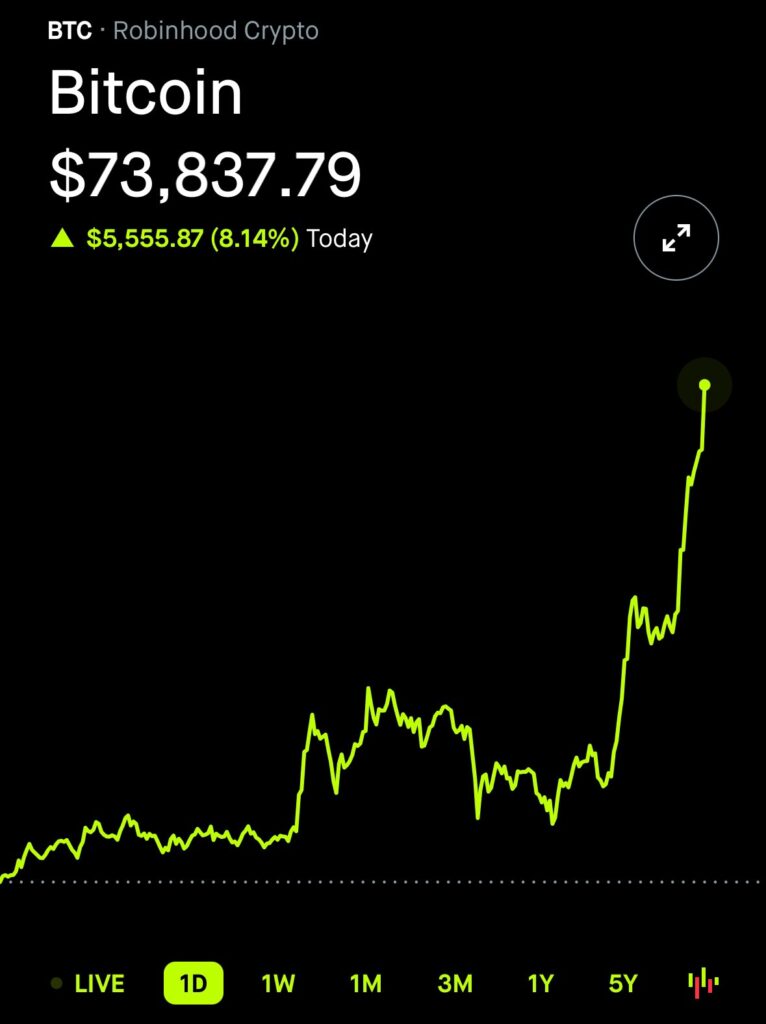
Bitcoin’s recent surge to an all-time high of $74.9K has electrified the financial world. While price rallies are nothing new in the volatile crypto market, this particular movement carries a unique twist—the anticipation of political change in the U.S. With the presidential election on the horizon, a Trump victory could dramatically reshape the landscape for Bitcoin and the broader crypto industry.

Why the Trump Factor?

Donald Trump’s previous administration was marked by deregulation and a willingness to embrace innovation, including aspects of fintech and emerging technologies. While his stance on cryptocurrencies has had mixed interpretations, a return to the White House could signal more lenient regulatory policies, potentially creating a more favorable environment for digital assets.

What This Could Mean for Bitcoin:

1. Pro-Crypto Regulatory Stance: If Trump were to return to office, many analysts believe that we could see a continuation of his deregulatory approach, creating opportunities for Bitcoin and other cryptocurrencies to thrive. A political shift like this could make the U.S. a more attractive hub for crypto firms and investors, pushing Bitcoin prices even higher.

2. Increased Institutional Confidence: Political stability and clear regulatory frameworks are key for large-scale investments. The prospect of policies that favor financial innovation might embolden institutions to deepen their positions in Bitcoin and blockchain technology. A Trump-led administration could remove some of the uncertainty that has kept cautious investors on the sidelines.

3. Global Ripple Effects: A U.S. president supportive of deregulated financial practices could have international implications. Global markets often follow the U.S.’s lead, and a pro-crypto administration could influence other nations to adopt similar stances, accelerating the global acceptance of Bitcoin.

Market Sentiment Speaks Volumes:

The current price surge shows that the market is already factoring in this potential political outcome. Traders are positioning themselves early, betting that the regulatory tide could shift to their favor. Bitcoin’s performance reflects not just a response to domestic politics but an anticipation of how global financial policies might pivot if the U.S. signals a new chapter for cryptocurrency.

Risks and Realities:

However, a Trump victory isn’t a guaranteed win for Bitcoin. While some predict a favorable regulatory shift, others warn that political unpredictability could still pose challenges. Past remarks from Trump himself have been contradictory—once calling Bitcoin a “scam,” but also recognizing the potential of blockchain and fintech.

Looking Forward:

Bitcoin’s climb to $74.9K may just be the beginning of a broader movement influenced by political and financial currents. As the 2024 U.S. presidential election approaches, the crypto world will be watching closely. A Trump victory could pave the way for a new era of digital finance—potentially fast-tracking Bitcoin’s journey toward further institutionalization and adoption.

Conclusion: Embracing a New Financial Era

Whether you’re a seasoned investor or new to the crypto scene, understanding the influence of global politics on the market is essential. A potential Trump win may herald changes that extend far beyond national policies, impacting the global stance on digital assets. Bitcoin’s recent all-time high isn’t just a spike—it could be the start of a transformative period in the financial world.

Stay connected with FutureFinanceLab.com for more insights, analysis, and updates as we navigate this thrilling chapter in crypto and finance.

How the 2024 U.S. Presidential Election Might Impact Bitcoin and Stocks

The 2024 U.S. presidential election, featuring Donald Trump and Kamala Harris, could significantly influence financial markets. Elections often bring short-term volatility, and this one is no exception. Here’s how each candidate’s policies might impact stocks and Bitcoin.

1. Stock Market Reactions

Historically, elections stir market uncertainty. A Trump victory might trigger a rally, given his pro-business stance that favors deregulation and tax cuts. This could boost growth sectors like tech and finance. On the other hand, a Harris win would likely maintain the current policy path, focusing on steady economic support but potentially with less dramatic market impact. Sectors like renewable energy and healthcare could see benefits under her leadership.

2. Bitcoin and Cryptocurrency

Bitcoin’s response to political changes is unique, driven by global sentiment and regulatory factors. If Trump wins, expectations of lighter crypto regulations could fuel optimism and push Bitcoin prices higher. Harris, however, may take a more cautious approach, balancing crypto growth with stronger oversight. The market impact could be more subdued but stable.

3. Federal Reserve and Monetary Policy

The Federal Reserve’s post-election meeting is key. A widely expected rate cut could inject liquidity into the market, benefiting Bitcoin as investors seek inflation hedges. Looser monetary policy historically supports riskier assets like stocks and cryptocurrencies.

Conclusion

While immediate reactions will vary based on the election outcome, the long-term effects depend on enacted policies. Stocks may surge with Trump’s deregulatory push, while Harris’s focus might foster stability and boost specific sectors. Bitcoin could thrive under either scenario: bullish with Trump due to regulation relief or steady under Harris as a safe, decentralized asset amid tighter oversight.

Crypto Market Analysis: Bitcoin Volatility and XRP’s Strategic Moves

Bitcoin’s recent 24-hour price drop from $73.4K to $69K has reignited concerns over market volatility. This sudden plunge comes amid mixed market sentiment, with the Fear & Greed Index standing at a neutral 59. Bitcoin’s dominance rose slightly to 60.25%, signaling a cautious return to the leading cryptocurrency during uncertain times.

Key Influences on Bitcoin:

1. Mt. Gox Movements: The dormant entity shifted $35 million in Bitcoin while pushing repayment deadlines to 2025, sparking fears of a potential market dip similar to previous large-scale Bitcoin liquidations.

2. Tether’s Strategic Investments: Tether, with its $7.7 billion profit and $134.4 billion in assets, is now investing in Bitcoin mining and AI. This move suggests confidence in Bitcoin’s long-term value but may also signal a shift towards diversification.

XRP’s Emerging Role:

A major development for XRP is the launch of Aurum’s $1 billion tokenized fund for data center investments on the XRP Ledger, in collaboration with Zoniqx. Touted as the world’s first combined equity and debt tokenized fund, this project spans key regions like the U.S., UAE, and Europe, showcasing XRP Ledger’s capabilities in facilitating large-scale financial operations efficiently.

Implications:

For Bitcoin: Investors should watch for potential market movements from Mt. Gox or strategic expansions by Tether, which could impact price stability.

For XRP: The Aurum fund could drive new institutional interest and broaden XRP’s use case, enhancing its market value if the project succeeds.

Overall, the market reflects a blend of caution and opportunity, where strategic investment and emerging blockchain applications are at the forefront, but concerns over manipulation and regulatory scrutiny linger.

Bitcoin’s Big Bounce? Price Dips to $69,000 as Wall Street and State Governments Eye the Crypto Giant

In the last 24 hours, Bitcoin’s price has taken a sharp dip from $73,000 to $69,000, but there’s more at play than a simple price drop. Behind the scenes, Wall Street and government officials are making moves that could push Bitcoin into new territory. Here’s a look at why this latest dip might just be the setup for Bitcoin’s next big leap.

  1. BlackRock’s Record Inflows Show Institutional Confidence
    Despite Bitcoin’s price drop, BlackRock’s Spot Bitcoin ETF just recorded its largest-ever inflows, showing that big money isn’t phased by the dip. When institutions like BlackRock buy in heavily during a downturn, it’s usually a sign of faith in long-term gains. While retail investors may be rattled, these institutional players see this as an opportunity, hinting that the price drop could be short-lived.
  2. MicroStrategy Sticks to Its Guns
    MicroStrategy’s Q3 earnings report may have missed estimates, causing its stock to fall nearly 6%, but CEO Michael Saylor remains bullish on Bitcoin. Saylor’s firm continues to hold a significant Bitcoin reserve, showing his commitment to its potential despite price fluctuations. For crypto watchers, this reinforces the idea that Bitcoin remains a solid long-term investment, even if the short-term ride gets bumpy.
  3. Florida’s Bold Bitcoin Proposal
    Florida’s CFO, Jimmy Patronis, recently proposed adding Bitcoin to the state’s pension funds, a move that could pave the way for other states to consider crypto investments. This marks a major step in mainstream acceptance of Bitcoin. Though government involvement could bring increased regulation, it also signals confidence in Bitcoin’s future stability and value.
  4. Correction or Opportunity? Bitcoin’s Slide to $69,000
    Bitcoin’s drop to $69,000 may be part of a natural correction after reaching recent highs. Corrections like these often create buying opportunities for new investors or those looking to add to their portfolios. And with a strong base of institutional and governmental interest, the price may rebound sooner rather than later.

Where Does Bitcoin Go from Here?
While Bitcoin’s recent price dip might seem like a setback, the underlying story is one of strength. With major institutions increasing their holdings and governments beginning to see Bitcoin as a viable asset, the stage is set for Bitcoin to push higher in the near future. For investors, this could be a golden moment—whether to enter or hold steady, as Bitcoin’s long-term outlook remains promising.

For now, Bitcoin may be down, but with heavyweights betting on its future, it’s far from out. Keep watching; this dip could be the beginning of a new chapter.

Bitcoin Breaks $71,000: What’s Driving the Surge and What’s Next?

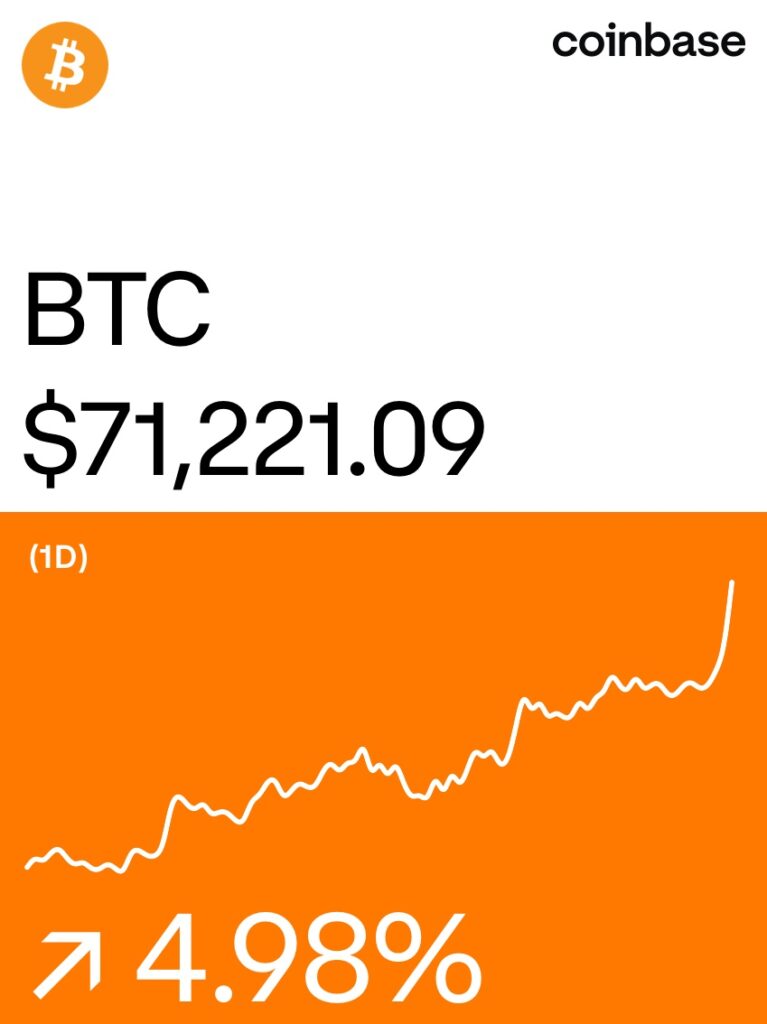
Bitcoin recently soared past $71,000, marking a nearly 5% daily gain and sparking renewed enthusiasm in the market. The rally, occurring just after Bitcoin’s latest halving, reflects a unique combination of reduced supply, institutional interest, and economic conditions pushing investors toward alternative assets. Here’s a look at the key factors driving this surge and what might lie ahead.

Key Drivers Behind Bitcoin’s Rally

1. Institutional Demand and ETF Hopes

The potential approval of a U.S. spot Bitcoin ETF is a significant catalyst. Such an ETF would make Bitcoin accessible to mainstream investors through traditional financial channels. Major institutions like BlackRock and Fidelity are backing ETF applications, fueling optimism that approval could bring billions in new demand, pushing prices higher.

2. Reduced Post-Halving Supply

With the recent halving, the reward for Bitcoin miners has been cut in half, limiting new supply. Historically, these post-halving periods have seen price increases as demand outpaces available Bitcoin, and current price action suggests this dynamic is playing out again.

3. Economic Uncertainty Driving Demand

Global economic instability, inflation, and high-interest rates are leading investors to consider Bitcoin as a hedge. As “digital gold,” Bitcoin’s appeal grows in uncertain times, attracting both retail and institutional investors.

What’s Next for Bitcoin?

Short-Term Outlook

While profit-taking could cause minor pullbacks, if Bitcoin maintains support above $70,000, it may continue its upward momentum. However, the market remains sensitive to regulatory news, especially regarding the ETF approval.

Long-Term Potential

Post-halving, Bitcoin is positioned for sustained growth, driven by reduced supply, institutional accumulation, and wider adoption. If an ETF is approved, it could unlock substantial demand, possibly leading to a sustained bull run.

Final Thoughts

Bitcoin’s rise to $71,000 reflects strong post-halving dynamics, optimism around an ETF, and a global search for inflation-resistant assets. This rally could mark the beginning of a more mature phase for Bitcoin, with growing legitimacy and integration into the broader financial system. For investors, Bitcoin’s journey seems poised to continue upward, backed by both new demand and a shrinking supply.

“Latest in Crypto: Bitcoin Hits New Highs, Layer 2 Expansion, and Real-World Asset Tokenization”

Latest Updates in Finance and Crypto Market

1. Crypto Market Trends:

• Bitcoin’s price surged past $69,000, driven by optimism for potential all-time highs, as it enters a historically bullish period for crypto markets. The U.S. election campaign, with a possible Trump victory, adds to this positive sentiment due to his pro-crypto stance. Additionally, the market cap for USDT hit a record $120 billion, signaling increased confidence in stablecoins and the broader crypto market  .

• Retail interest in crypto is rising, with a notable shift toward derivatives trading, which reached $260 billion in volume this month. This trend shows retail investors favoring derivatives over spot trading, adding to overall market activity .

2. Regulatory and Institutional Developments:

• The SEC’s approval of options trading for spot Bitcoin ETFs on major U.S. exchanges signals increased institutional involvement. This development is anticipated to further strengthen the Bitcoin market. Additionally, Pennsylvania’s proposed “Bitcoin Rights Bill” could enhance state-level support for Bitcoin transactions  .

3. Layer 2 Growth and Tokenization:

• Ethereum is facing challenges in retaining a deflationary model, as Layer 2 solutions drive down mainnet activity. Meanwhile, tokenization of real-world assets (RWAs) like private credit and U.S. treasuries has grown significantly, exceeding $12 billion and highlighting blockchain’s appeal for tangible asset management .

4. Security and DeFi:

• Security remains a concern, with $1.3 billion lost in hacks in 2024, although security measures are improving. DeFi has seen positive growth, with total value locked (TVL) up 9.6%, led by chains like Sui and Sei that have introduced protocol upgrades, increasing their DeFi activity .

These developments reveal a market driven by institutional confidence and technological progress, even as challenges persist around security and regulatory clarity.

Sources:

Finbold, CoinSwitch   

FinanceFeeds 

BeInCrypto 

https://decrypt.co/crypto-news/bitcoin

Worldcoin: Potential Red Flags You Shouldn’t Ignore

Worldcoin: Potential Red Flags You Shouldn’t Ignore

In the world of crypto and decentralized finance, Worldcoin is one of the latest projects capturing attention. Promising a vision of universal financial inclusion, it sounds appealing at first glance. However, a deeper look reveals some significant concerns. Here are some critical red flags to consider before getting involved in Worldcoin.

1. Privacy and Security Risks

One of the most controversial aspects of Worldcoin is its requirement for iris scanning to verify user identity. Biometric data like your iris scan is sensitive and, once collected, can never be changed or undone. Despite claims that the data is anonymized and stored securely, any data breach could expose users to serious security and privacy risks.

Further, biometric data can be misused, leading to identity theft or unauthorized surveillance. Unlike a password, which you can reset, your iris scan is unique and permanent. Even with security assurances, many experts warn that this kind of data collection opens the door to potential misuse.

2. Centralization and Control

Though Worldcoin markets itself as part of the decentralized finance (DeFi) movement, the reality is that a centralized company manages and controls the project. Decentralization is a cornerstone of blockchain technology because it reduces the risk of control by a few individuals or entities. In Worldcoin’s case, central management means a small group retains significant control, potentially allowing them to make unilateral decisions or manipulate aspects of the network.

This centralization raises concerns about transparency, accountability, and the project’s commitment to the principles of decentralized finance. When one entity holds too much power, the project can become vulnerable to conflicts of interest or even future regulation pressures.

3. Data Exploitation of Vulnerable Populations

Worldcoin has primarily targeted economically disadvantaged areas by offering small financial incentives to users willing to share their biometric data. Critics argue that this approach preys on financially vulnerable individuals who may not fully understand the potential long-term implications of sharing their sensitive data.

By providing small amounts of cryptocurrency in exchange for biometric data, the project risks becoming exploitative. Individuals in these communities might feel compelled to participate for the immediate financial reward, without a complete understanding of what they’re giving up. This raises ethical questions about consent and whether Worldcoin truly aims to empower these individuals or is simply using their data for corporate gain.

4. Uncertain Financial Model

While Worldcoin promises universal financial access, the project’s economic model is somewhat vague. Its long-term sustainability depends on widespread adoption and continued investment. If the project doesn’t reach the critical mass of users it needs, there’s a chance that early participants could find themselves in a devalued system.

Furthermore, Worldcoin’s value relies heavily on hype, which is a common red flag for projects that might not have a solid foundational structure. Any collapse in user interest or funding could leave participants with nothing.

5. High Risk of Regulatory Backlash

With privacy and data protection laws tightening globally, Worldcoin’s model could face regulatory challenges. Governments worldwide are implementing strict regulations on how companies collect, store, and manage biometric data. There’s a real possibility that Worldcoin’s data collection practices could become illegal or heavily restricted in certain regions, which would disrupt its operations.

A legal crackdown could have serious financial implications for the project and, by extension, for those who have invested time, data, and resources into it. Participants may face restrictions on using their Worldcoin tokens or find themselves unable to access or transfer their assets.

6. Lack of Transparency and Clear Communication

Finally, many participants have pointed out that Worldcoin lacks transparency in its operations and goals. While the project boasts a noble vision of financial inclusion, there are few concrete details about how it plans to achieve this sustainably. Moreover, the project hasn’t provided clear information about data security, revenue models, and long-term goals.

When projects lack transparency, it’s often a sign that they’re hiding potential issues. Transparency is essential in building user trust, particularly in finance, where participants need to know how their data will be used, who has access to it, and what protections are in place.

Final Thoughts

Worldcoin’s mission to create universal financial inclusion through digital identity might sound groundbreaking, but the execution raises serious questions. From privacy risks to ethical concerns, centralization, and regulatory challenges, there are several red flags that potential users should carefully consider. It’s essential to approach any new technology, especially in finance, with caution and critical thinking.

Always remember, your biometric data is one of the most personal forms of identification. Giving it away for a small incentive might not be worth the potential risks down the line. If you’re considering getting involved with Worldcoin, be sure to weigh these concerns thoroughly and stay informed about the project’s development.

*https://gokhansakalli.medium.com/worldcoin-potential-red-flags-you-shouldnt-ignore-d1a4eef20659

The Autonomous Economy: How AI, Blockchain, and Robots Are Shaping the Future

The future is arriving faster than we think, with advancements in artificial intelligence (AI), blockchain, and robotics creating a new economic landscape known as the “autonomous economy.” In this world, machines, algorithms, and decentralized networks will increasingly handle tasks that once required human intervention, from financial transactions to manufacturing processes. Here’s a two-minute overview of what the autonomous economy means for Americans and how these technologies could transform daily life.

What Is the Autonomous Economy?

The autonomous economy refers to an economic system where AI, blockchain, and connected devices operate independently to manage tasks like supply chains, energy consumption, and financial services. The aim is to create more efficient, transparent, and cost-effective systems, reducing the need for manual processes and human decision-making.

Decentralized Decision-Making and Smart Contracts

Blockchain plays a key role by providing a secure, decentralized network where transactions are verified without the need for intermediaries. Smart contracts — self-executing agreements coded on the blockchain — automate tasks like processing payments, executing trades, or even scheduling maintenance for machinery. Imagine a world where your electric car autonomously pays for charging or where machines order replacement parts without human input.

The Decentralized Data Economy

In the autonomous economy, data is not just collected by companies; it becomes a shared asset in a decentralized data economy. Powered by blockchain, individuals and devices can securely share and even monetize their data without relying on large, centralized corporations. For example, autonomous vehicles could share traffic data with city planners or other cars in real-time, improving urban mobility. In return, individuals might receive compensation in tokens or credits for their data, creating a new form of passive income.

Machine-to-Machine Transactions

The Internet of Things (IoT) and connected devices are also shaping the autonomous economy. In smart cities, for example, autonomous vehicles could interact directly with parking meters, toll stations, and even other cars to optimize routes and reduce traffic. Similarly, smart home devices could manage energy usage based on real-time electricity prices, autonomously buying and selling energy through a decentralized grid.

AI-Driven Automation Across Industries

AI is at the heart of the autonomous economy, driving automation in industries ranging from finance to manufacturing. In the financial sector, AI can manage investments and execute trades, while in factories, robots equipped with AI can oversee production lines, ensuring optimal performance. The result is a more efficient, self-sustaining system that adapts to changing market conditions on its own.

Benefits and Challenges

The autonomous economy promises to boost productivity and lower costs, potentially leading to new business models and economic growth. However, there are challenges, including cybersecurity risks, regulatory hurdles, and the impact on employment as jobs shift from manual to automated tasks. Balancing these benefits with ethical and social considerations will be crucial as the autonomous economy evolves.

The Road Ahead

While the autonomous economy is still emerging, its impact will be profound. Americans can expect more connected devices, smarter cities, and seamless digital interactions. As AI, blockchain, and robotics continue to advance, the way we live and work will be reshaped — ushering in a future where autonomy is the new normal.

The autonomous economy isn’t just a tech buzzword; it’s a glimpse into a world where technology seamlessly integrates into our daily lives, making systems smarter, more efficient, and more capable than ever before. And with the decentralized data economy, individuals will have more control over their information, allowing them to participate in and benefit from the data-driven future.

How Blockchain and Bitcoin Can Help Prevent IT Outages: Lessons from the CrowdStrike and Microsoft Incident

On a recent Friday, a widespread IT outage caused by a faulty software update from U.S. cybersecurity firm CrowdStrike disrupted government services and businesses across the country. The incident, which included Microsoft’s infamous “blue screen of death,” affected emergency call centers, banks, airlines, and hospitals, highlighting the significant market share and influence both companies hold in their respective sectors.

This event serves as a painful wake-up call about the vulnerabilities in our current IT infrastructure. However, emerging technologies like blockchain and Bitcoin offer promising solutions to prevent such problems in the future.

The Problem with Centralized Systems

Centralized IT systems, where a single point of failure can disrupt entire networks, are inherently vulnerable. In the case of the CrowdStrike and Microsoft outage, a single software update caused widespread disruption. This centralized nature means that any malfunction or cyberattack can have catastrophic consequences, as was evident in this incident.

How Blockchain Can Help

  1. Decentralization:

Blockchain technology operates on a decentralized network, eliminating a single point of failure. In a blockchain network, data is distributed across multiple nodes (computers), ensuring that no single entity has control over the entire network. This decentralization makes it significantly harder for an outage to occur, as the system can continue to operate even if some nodes fail.

2. Immutable and Transparent Records:

Blockchain’s immutable ledger ensures that all transactions and data entries are transparent and cannot be altered or deleted. This feature can help prevent the introduction of faulty updates, as all changes would be recorded and could be easily audited. If an issue arises, it can be quickly identified and traced back to its source, allowing for faster resolution.

3. Enhanced Security:

Blockchain uses cryptographic techniques to secure data, making it highly resistant to tampering and unauthorized access. This enhanced security can protect against cyberattacks, which are a significant risk for centralized systems. With blockchain, data integrity is maintained, reducing the likelihood of an outage caused by malicious activities.

The Role of Bitcoin and Cryptocurrencies

Bitcoin, the first and most well-known cryptocurrency, operates on a blockchain network. Beyond its use as a digital currency, Bitcoin’s underlying technology offers several benefits for IT systems:

  1. Resilient Infrastructure:

Bitcoin’s blockchain is one of the most secure and resilient networks in existence. Its proof-of-work consensus mechanism ensures that all transactions are verified and recorded in a manner that is extremely difficult to tamper with. This robust infrastructure can serve as a model for developing more resilient IT systems.

2. Smart Contracts:

Smart contracts are self-executing contracts with the terms of the agreement directly written into code. They run on blockchain networks like Ethereum and can automate processes, reducing the need for manual intervention. In the context of IT updates, smart contracts could automate the deployment and verification of software updates, ensuring they are applied correctly and without causing disruptions.

Case Study: Preventing Future Outages

Imagine a scenario where critical IT infrastructure is built on a blockchain network. Instead of relying on a single entity to manage and distribute software updates, updates could be deployed through a decentralized system where multiple nodes verify and validate the update before it is applied. This process would prevent faulty updates from being widely distributed, as the decentralized nature of blockchain ensures that updates are thoroughly vetted.

Furthermore, in the event of an attempted cyberattack, the blockchain’s security features would make it much harder for attackers to succeed. Even if some nodes were compromised, the rest of the network would continue to operate, preventing a complete outage.

Conclusion

The recent IT outage caused by a CrowdStrike software update underscores the vulnerabilities in our centralized IT systems. Blockchain and Bitcoin offer promising solutions to enhance the resilience, security, and transparency of IT infrastructures. By leveraging these technologies, we can build systems that are better equipped to prevent and withstand outages, ensuring continuous and reliable services for critical sectors.

Sources

Schulz, B., Wellington Radel, F., & Meyer, J. (2024). “’Painful’ wake-up call: What’s next for CrowdStrike, Microsoft after update causes outage?” USA TODAY.

Nakamoto, S. (2008). Bitcoin: A Peer-to-Peer Electronic Cash System.

Tapscott, D., & Tapscott, A. (2016). Blockchain Revolution: How the Technology Behind Bitcoin is Changing Money, Business, and the World.

Mougayar, W. (2016). The Business Blockchain: Promise, Practice, and the Application of the Next Internet Technology.