Why Taleb Is Wrong About Bitcoin (Again): The ‘Electronic Tulip’ That Keeps Blooming

There he goes again.

Nassim Taleb, once respected for his deep thinking on risk and uncertainty, now repeats tired comparisons, calling Bitcoin an “electronic tulip” as it pushes past $120,000.

The irony is that he’s missing the very kind of transformation he used to write about. Bitcoin isn’t a bubble. It’s a complete rethinking of trust, money, and digital ownership. And every time it’s dismissed, it gets stronger.


Let’s break down Taleb’s claims

1. “Bitcoin is too volatile to be a currency.”
Yes, for now. But that’s like criticizing the internet in 1995 for being too slow. Volatility is part of early-stage adoption. Gold was volatile once, too. Today’s fiat currencies are “stable” because they’re backed by central banks and manipulated with monetary tools.

Bitcoin is becoming more stable over time, as its network effects grow and institutional adoption increases.

2. “Bitcoin holders want it to rise. That’s not how currencies work.”
That’s true, but irrelevant to where Bitcoin is in its life cycle. Right now, it’s acting more like digital gold than a daily-use currency. First it becomes a store of value, then a medium of exchange. This is a natural progression in the development of any new form of money.

Taleb is expecting the end state before the infrastructure and understanding are fully in place.

3. “Governments won’t adopt it.”
Governments didn’t adopt the internet either, until they had no choice. Today, some are already engaging with Bitcoin directly or indirectly. El Salvador has made it legal tender. Others are stacking it in reserves, taxing it, regulating it, and watching closely.

The reality is that many fiat systems are under pressure. In that environment, Bitcoin becomes not a threat, but a viable hedge and alternative.


Bitcoin isn’t a tulip. It’s a system upgrade

Tulips never changed global economics. Bitcoin is doing exactly that. It has survived every major attack, every media hit piece, and every market crash. It is still running with 99.9 percent uptime, block by block, year after year.

While Taleb and others try to dismiss it with metaphors from centuries past, Bitcoin is creating a future-proof monetary network.

He’s not seeing it. But the rest of the world is starting to.

Final Thoughts from FutureFinanceLab:

Bitcoin isn’t perfect. But the criticism it faces often says more about the critic than the code.

The next time someone like Taleb calls it a “bubble,” remember he’s not investing in the future. He’s stuck defending the past.

Let them hate. You stay curious. You stay strategic. You keep learning.

Because in finance, as in life truth compounds.

FutureFinanceLab

Bitcoin Hits New All-Time High: What It Means for Crypto Investors in 2025

The king of crypto is back on top.

In a dramatic surge that captured the attention of investors worldwide, Bitcoin has officially hit a new all-time high, breaking past its previous peak and reinforcing its position as the most dominant digital asset in the world. This latest milestone is not just a price point—it’s a signal.

A signal that digital money is no longer a fringe concept.

Why This ATH Matters

Bitcoin’s new all-time high reflects more than speculation—it shows growing institutional adoptionrising inflation hedging, and global recognition of decentralized finance.

From major asset managers integrating Bitcoin into portfolios to global payment firms offering crypto services, the fundamentals backing this rally are stronger than ever.

This ATH is different.

It’s not fueled by hype alone—it’s supported by:

  • The growth of Bitcoin ETFs
  • Geopolitical shifts away from fiat dependence
  • Regulatory clarity in several key markets
  • And a maturing retail investor base looking for sound money in a digital world

Bitcoin: Still the Benchmark

Bitcoin continues to be the “digital gold” that institutions and individuals turn to first. Its scarcity (21 million cap), security, and network effects have set it apart as the most resilient crypto asset.

But the crypto story doesn’t stop there.

What About HBAR and XRP?

While Bitcoin dominates headlines, HBAR (Hedera Hashgraph) and XRP (Ripple) are quietly gaining traction with different, equally compelling use cases:

🌀 HBAR: The Enterprise Layer for Web3

Hedera’s unique consensus mechanism and enterprise partnerships (like Google, IBM, and LG) make it a serious player in real-world Web3 infrastructure. As tokenized assets, identity, and supply chain solutions expand, HBAR could play a foundational role.

🌊 XRP: The Bridge for Global Payments

Despite legal hurdles in recent years, XRP continues to push boundaries in cross-border finance. With RippleNet expanding globally and growing interest in CBDC interoperability, XRP is more than alive—it’s evolving.

A New Crypto Cycle?

If you’ve been on the sidelines, this is your wake-up call. Bitcoin’s ATH isn’t just a milestone—it’s a reminder of the massive shifts taking place in finance, technology, and trust.

The world is going digital. Is your portfolio ready?


💡 FutureFinanceLab Insight:
Don’t chase price. Understand value.
The smart investor looks beyond headlines and asks:

  • What is the long-term use case?
  • Who’s building?
  • What problem does this solve?

Bitcoin’s new high is a reflection of long-term belief—something every investor should study deeply.


Want to Learn More?

Join the FutureFinanceLab Membership for deeper insights, model portfolios, and private coaching as we navigate the next phase of the crypto and digital finance revolution.

How Compound Interest Works (And How to Use It to Get Rich)

Introduction: The Magic of Compound Interest

We’ve all heard the term “compound interest,” but what exactly is it? In short, compound interest is the process where interest earned on an investment is reinvested, generating additional interest. This creates a snowball effect, where your money starts working for you, accelerating growth over time. If you want to get rich, understanding and harnessing the power of compound interest can be one of the best financial moves you can make.


What is Compound Interest?

Compound interest is the idea of earning interest not just on your initial investment, but also on the interest that’s been added. For example, if you invest money and earn interest, that interest is added to your investment. The next time interest is calculated, it’s based on the original amount plus the interest already earned. Over time, this builds up and accelerates the growth of your investment.

Example:

Imagine you invest $1,000 at an interest rate of 5%. In the first year, you’ll earn $50 in interest, bringing your total to $1,050. In the second year, the 5% interest will be applied to $1,050, so you’ll earn $52.50. The next year, you’ll earn interest on the $1,102.50, and so on. The more time you leave your money to grow, the bigger the snowball becomes.


How to Use Compound Interest to Get Rich

Compound interest works best when you let your investments grow over a long period. Here are a few strategies to maximize its power:

1. Start Early

The earlier you start, the more time your money has to grow. Even small investments made early can lead to large amounts over time.

2. Reinvest Your Earnings

Rather than withdrawing your earnings, reinvest them back into your investment. This allows your wealth to keep growing, rather than stagnating.

3. Make Regular Contributions

Investing regularly, even small amounts, can significantly boost the power of compounding. The more you invest over time, the more your wealth grows.

4. Choose High-Interest Investments

Look for investments with high interest rates or returns. Stocks, bonds, and other assets that generate returns over time are perfect vehicles for compound growth.


Real-World Example: How Compound Interest Works in Practice

Here’s how compound interest can work in the real world:

Let’s say two people start investing at different times:

  • Investor 1 starts at age 25, investing $5,000 a year, with a return of 7% annually.
  • Investor 2 starts at age 35, investing the same amount with the same return.

By the time Investor 1 is 55, they will have accumulated over $700,000. But Investor 2, starting later, will have only around $350,000 by the same age. The difference? Time. Investor 1’s money has had more time to grow through compound interest.


Why Compound Interest is the Eighth Wonder of the World

Albert Einstein famously referred to compound interest as the “eighth wonder of the world,” and for good reason. It’s an incredibly powerful tool that can turn small, consistent contributions into substantial wealth over time.


The Risks of Compound Interest

While compound interest is a powerful wealth-building tool, it’s important to manage the risks:

  • Market Fluctuations: Investments like stocks or cryptocurrencies can be volatile.
  • Inflation: Inflation can erode the purchasing power of your returns.
  • Interest Rates: Keep an eye on the interest rates, as they can change and affect your returns.

How to Get Started with Compound Interest Today

If you want to harness the power of compound interest, start by:

  • Setting up a retirement account or an investment account that compounds returns.
  • Investing in a diversified portfolio to manage risk.
  • Reinvesting any earnings or dividends to maximize growth.

Conclusion: Start Using Compound Interest Now to Build Wealth

The key to wealth is leveraging time and compound interest. It’s not about making quick, speculative bets but making disciplined, consistent investments over time. The earlier you start and the more you contribute, the more powerful the effects of compounding will be. It’s the ultimate tool for building long-term wealth.

Ready to get started on your wealth-building journey? Join FutureFinanceLab.com to gain access to exclusive financial education tools, investment strategies, and insights that can help you make the most of your money. Learn more about how to put compound interest to work for you and start building your financial future today.

You Will Own Nothing and Be… Controlled? The Truth About Ownership, Wealth, and the Future of Finance

“You will own nothing and be happy.”
This phrase, popularized by futurists and institutions like the World Economic Forum, reflects a growing trend in today’s digital economy: convenience over ownership. On the surface, it seems harmless. After all, subscription services, shared economies, and platform-based access models are efficient, flexible, and easy to use.

But behind the convenience lies a more serious concern. If you do not own anything, you are not building wealth. You are helping someone else build theirs.

The Subscription Economy: Access Without Value

Modern life is increasingly defined by subscriptions. We rent homes, lease cars, stream content, and pay monthly for software, groceries, even clothing. At first, it feels like freedom. You are not tied down, you are always up-to-date, and you can cancel anytime.

But the more you rely on temporary access, the less you build long-term value. You are paying for use, not ownership. And the money you spend is funding the assets and wealth of those who own the systems you rely on.

Access is not ownership. It is consumption.

Why Ownership Still Matters

Real wealth is not built by spending money. It is built by owning things that either grow in value or generate income. This is not a new idea. It is the foundation of financial independence.

Consider the alternatives:

  • Owning a home means building equity, not just paying rent
  • Owning a stock means benefiting from company profits
  • Owning a business means creating recurring revenue
  • Owning intellectual property means earning from your ideas
  • Owning digital assets like Bitcoin means controlling your financial future

When you own, your money works for you. When you rent, you are working for someone else’s asset base.

Bitcoin and Digital Property Rights

Bitcoin offers a unique kind of ownership in the digital age. It is not a subscription, and it does not rely on intermediaries or platform permissions. When you hold Bitcoin in a self-custodied wallet, it is fully yours. It cannot be inflated, frozen, or devalued by third parties.

Bitcoin represents a form of digital property that is scarce, portable, and global. Unlike a song on a streaming service or a social media post that can be removed, Bitcoin is not permissioned access. It is ownership.

And ownership is power.

The Cost of Owning Nothing

Renting everything might feel modern, but it creates long-term dependence. You are always one price increase, one policy change, or one service outage away from disruption. You are not in control of the tools, the platforms, or even your money.

When you own nothing, you are always paying. And when you are always paying, you are always serving someone else’s goals, not your own.

Build, Don’t Just Subscribe

If you want financial security, you need to start owning. That does not mean rejecting all subscriptions or conveniences, but it does mean thinking critically about where your money goes.

Start by investing in:

  • Assets that appreciate
  • Businesses you can control
  • Digital property with long-term value
  • Skills and knowledge that compound
  • Platforms and tools that you own, not just use

Conclusion

Ownership is not outdated. It is more important than ever. In a world that encourages endless renting and constant consumption, those who choose to own will be the ones who create freedom, flexibility, and wealth.

You do not need to own everything. But you must own something.

Because without ownership, there is no leverage. And without leverage, there is no financial freedom.

$4.9 Trillion Lost: What the 2025 Market Drop Means—and What’s Next for Investors (Including Bitcoin)

The U.S. stock market has just lost $4.9 trillion in value over the past six weeks, marking one of the most aggressive wealth contractions in recent history. But unlike past sell-offs, there’s a major new player on the field: Bitcoin.

Is this just another correction—or the beginning of a deeper shift in where investors seek refuge and growth?


Why Did the Stock Market Drop in 2025?

Multiple headwinds are converging:

• Geopolitical uncertainty (trade wars, elections, global instability)

• Persistent inflation that’s proving hard to tame

• Confusing Fed policy signals on interest rates

• Disappointing earnings from top S&P 500 companies

• Rising recession fears and stagflation risks

• Bearish investor sentiment at its highest since early 2020

These factors have triggered one of the sharpest drawdowns since the pandemic era.


How Bitcoin Is Reacting

Unlike traditional markets, Bitcoin has been showing signs of relative strength:

• BTC has gained ~15–20% during the same 6-week period in which equities lost trillions.

• Investors are increasingly viewing Bitcoin as “digital gold”—a hedge against fiat debasement and policy risk.

• Institutional flows into Bitcoin ETFs and custody services have reached new highs in early 2025.

While still volatile, Bitcoin is proving to be a non-correlated asset class that thrives when confidence in traditional markets erodes.

Search trend spikes for “Bitcoin during market crash” and “safe haven crypto” support this shift in sentiment.


Historical Context: This Drop vs Past Crashes

Crash/EventValue LostDurationTrigger
COVID-19 (2020)~$6–7 trillion~2 monthsPandemic panic
GFC (2008–2009)~$8 trillion~17 monthsFinancial system breakdown
Dot-com Bubble~$5 trillion~2.5 yearsTech overvaluation
Current (2025)$4.9 trillion~6 weeks (so far)Inflation, geopolitics, Fed
Bitcoin 2025+15–20%Same periodSeen as hedge asset

What Smart Investors Are Doing in 2025

1. Rotating to Quality and Defensive Assets

• Sectors: Healthcare, consumer staples, utilities

• Alternative assets: Bitcoin, gold, and silver

2. Rebalancing & Diversifying

• Reducing overexposure to overvalued equities

• Increasing exposure to non-correlated assets like crypto and commodities

• Exploring inflation-protected securities (TIPS, real assets)

3. Staying Long-Term Focused

• Market corrections are painful—but often present long-term opportunity

• Bitcoin and equities can coexist in a diversified modern portfolio


Investor Sentiment: Fear High, But Opportunity Rising

• The AAII bearish sentiment is over 50%

• Volatility indexes (VIX) are elevated

• Institutional investors are sitting on record amounts of dry powder

Translation? Fear is high—but so is opportunity. Bitcoin’s rise amid a collapsing equity market is sparking real conversations about asset allocation in the digital age.


Final Takeaway: A New Market Cycle May Be Forming

This $4.9 trillion drop could be the start of a new era—where capital flows aren’t just about stocks and bonds, but also Bitcoin and other digital assets.

Historically, every crash reshapes the investment landscape. 2025 may be remembered not just for what the stock market lost, but for what investors discovered—alternative, decentralized stores of value that thrive on volatility and uncertainty.


Actionable Steps

• Reassess your exposure to equities, crypto, and cash

• Stay informed on Fed moves, inflation data, and BTC adoption trends

• Consider Bitcoin as part of your diversification strategy—especially during volatile times

Want Deeper Insights, Tailored to You?

This $4.9 trillion market shake-up is just the beginning. If you’re serious about navigating today’s complex markets—and preparing for the next wave of opportunity—it’s time to level up your strategy.

At FutureFinanceLab, our members get exclusive access to:

• Personalized AI-powered market insights

• Real-time investor sentiment tracking

• In-depth breakdowns of macro trends, Bitcoin, and emerging assets

• Curated educational resources for all experience levels

• Monthly webinars, reports, and strategy sessions

• A growing community of forward-thinking investors and traders

Join FutureFinanceLab today and transform how you understand, analyze, and act in the markets.

Mode Mobile’s Red Flags and Robinhood Snacks’ Ethical Misstep

Introduction: Trust at Stake

Robinhood Snacks, a popular newsletter known for delivering financial insights in bite-sized chunks, recently promoted Mode Mobile, a company that claims to pay users for smartphone usage. However, a deeper look into Mode Mobile reveals glaring issues, raising concerns about Robinhood Snacks’ decision to feature such a company. The incident highlights the importance of ethical responsibility in financial media.

Mode Mobile: Too Good to Be True?

Mode Mobile markets itself as a groundbreaking platform that rewards users for smartphone activities, all while tying its vision to the concept of Universal Basic Income (UBI). But beyond the flashy marketing lies a series of red flags:

1. Negative Feedback from Users

On platforms like Reddit, Mode Mobile has faced waves of criticism. Users frequently report:

• Payment delays or outright non-payment.

• Buggy apps that hinder earning potential.

• Poor customer service and lack of accountability.

These complaints paint a picture far removed from the optimistic image Mode Mobile presents.

2. Questionable Claims

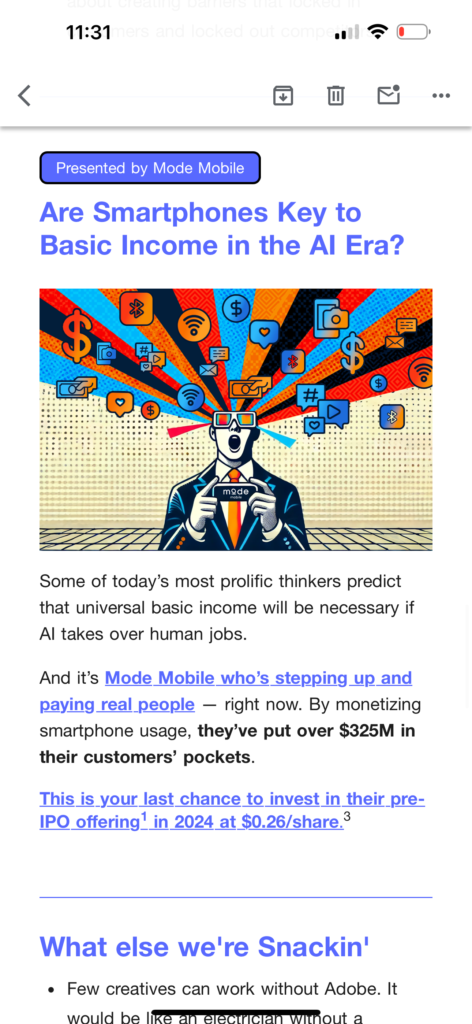
The company asserts it has “put $325M in their customers’ pockets.” But where’s the proof? Such large numbers demand transparency. There’s little evidence provided to substantiate these claims, raising doubts about their validity.

3. Website Red Flags

Vague Language: Key details about how payments are calculated, risks involved, or user protection are notably absent.

Pre-IPO Investment Push: The heavy emphasis on investing in their $0.26/share pre-IPO feels more like a cash grab than a legitimate opportunity.

4. Exploiting UBI

Tying their platform to UBI, a concept designed to combat systemic inequality, feels disingenuous. It’s more of a marketing strategy than a real effort to support social change.

Robinhood Snacks’ Oversight

Robinhood Snacks has built its reputation as a reliable source of financial news, simplifying complex topics for everyday readers. By promoting Mode Mobile, they risk undermining the trust they’ve cultivated over the years.

1. Breach of Trust

Readers expect Robinhood Snacks to vet the companies they feature. Including Mode Mobile without thorough due diligence feels careless and irresponsible, particularly given the negative sentiment surrounding the company.

2. Ethical Responsibility

Financial newsletters have influence. A promotion in Robinhood Snacks gives credibility to the featured business. In this case, that credibility was extended to a company with serious allegations of unethical practices.

3. Impact on Readers

Many readers may now associate Robinhood Snacks with this potentially exploitative company, harming their brand image. Worse, some may even fall for Mode Mobile’s promises, wasting time, money, or both.

The Bigger Issue: Accountability in Financial Media

This isn’t just about one company or one newsletter. It’s about the broader role financial media plays in informing and protecting consumers. With great influence comes great responsibility. If Robinhood Snacks fails to uphold ethical standards, it opens the door for other questionable promotions, further eroding trust in the industry.

Call to Action

1. Robinhood Snacks Must Address This

The newsletter should issue a statement addressing why Mode Mobile was featured and outline steps they will take to ensure proper vetting of future promotions. Transparency is key to restoring reader trust.

2. Readers Must Stay Vigilant

Never take a company’s claims—or a newsletter’s endorsement—at face value. Research independently and look for warning signs like vague terms, unsubstantiated claims, and user complaints.

3. Mode Mobile Needs Accountability

For Mode Mobile, the scrutiny should prompt a reevaluation of their practices. If they are serious about their mission, they must address user complaints, provide evidence for their claims, and operate with full transparency.

Conclusion: A Lesson for All

This incident is a wake-up call for both financial media and consumers. Robinhood Snacks must do better, and readers must remain cautious. In an era where information spreads fast and unchecked, maintaining trust requires vigilance, accountability, and ethical standards.

As for Mode Mobile, their promises sound enticing—but sometimes, if it seems too good to be true, it probably is.