Global Crises and Bitcoin: What Happens to Crypto in Uncertain Times?

From wars and recessions to inflation and political instability, global crises shake markets—and leave investors wondering: Is Bitcoin a safe haven or just another risk asset?

In this simplified breakdown, we’ll look at how Bitcoin reacts during uncertain times, how it compares to stocks and real estate, and what that means for your portfolio.


🌍 What Do We Mean by “Global Crisis”?

Crises come in different forms, each with different market reactions:

  • Recessions (e.g., 2008, COVID-19)
  • Wars and geopolitical tension (e.g., Ukraine-Russia, Israel-Gaza)
  • Inflation and currency collapse (e.g., Argentina, Turkey)
  • Financial system failures (e.g., bank runs, credit freezes)

During these moments, traditional investors typically move toward safety—like cash, U.S. Treasury bonds, or gold. So where does Bitcoin fit in?


📉 Bitcoin During Global Crises: Not Always a Safe Haven

Short-Term Volatility

Historically, Bitcoin has often dropped sharply during sudden crises—similar to stocks. This is because:

  • Investors rush to liquidity (selling BTC to get cash)
  • Bitcoin is still seen as a risk-on asset by institutions
  • Markets get driven by fear, not fundamentals

Example:

  • March 2020 (COVID Crash):
    • Stocks plunged
    • Bitcoin dropped over 50% in a week
    • But it recovered faster than many traditional assets

💡 Bitcoin’s Long-Term Narrative: “Digital Gold”

Despite short-term panic, Bitcoin is increasingly seen as:

  • hedge against inflation
  • A store of value outside of government control
  • A tool for financial sovereignty, especially in unstable regions

In countries with hyperinflation or authoritarian regimes, Bitcoin adoption rises during crisis, even if prices remain volatile.


🏠 How It Compares to Stocks and Real Estate

AssetCrisis Reaction (Short-Term)Crisis Reaction (Long-Term)LiquidityGovernment Control
BitcoinHigh volatilityGrowth in adoption, uncertain valueHighLow
StocksUsually declineOften recover with economyHighMedium
Real EstateMore stable short-termDependent on rates/economyLowHigh

🔐 Real-World Use Cases During Crisis

  • Ukraine War: Donations in Bitcoin and stablecoins bypassed banks
  • Argentina & Venezuela: Locals used BTC to escape currency collapse
  • Canada 2022: Bitcoin used to send money during government bank freezes

These examples show Bitcoin’s utility, not just its price.


🧠 What Should You Do During Crisis?

  1. Stay calm: Crypto is volatile panic selling locks in losses
  2. Diversify: Don’t put everything in BTC or stocks
  3. Zoom out: Look at long-term trends, not headlines
  4. Use cold storage: If governments or banks become unstable, custody matters

📈 Key Takeaway

Bitcoin isn’t bulletproof during crisis but it’s a different kind of asset:
Decentralized, global, and uncorrelated over the long term. While stocks and real estate depend on governments and interest rates, Bitcoin’s value proposition is based on scarcity, transparency, and independence.

In uncertain times, understanding what each asset does not just how it moves can help you build smarter financial strategies.


For more simplified crypto content, visit FutureFinanceLab.com

Why Smart Investors Ignore the Noise (Even in Crypto)

Diversified investment portfolio with crypto allocation

In a world where headlines change faster than markets can react, investors face a constant temptation: do something. But more often than not, that urge does more harm than good.

Whether it’s political uncertainty, inflation fears, interest rate debates, or market volatility, the smart move is often counterintuitive:

Tune out the noise — and stick to what works over time.


The Problem With Short-Term Reactions

Let’s be honest: predicting markets based on headlines is a losing game.

  • Trade tariffs, wars, or elections may sound impactful, but rarely translate into predictable outcomes.
  • Even professional managers who try to tactically shift portfolios underperform static, balanced strategies.
  • From 2005 to 2025, tactical asset-allocation funds trailed simple 60/40 portfolios by up to 2–3% per year.

That’s a significant drag — and one that’s often driven by reacting emotionally rather than thinking strategically.


Enter Bitcoin: The New Long-Term Benchmark

While stocks, bonds, and gold all play roles in a diversified portfolio, Bitcoin stands apart.

  • Over the past decade, Bitcoin has outperformed every traditional asset class, even after brutal drawdowns.
  • It’s the only major asset with a fixed supply, growing global adoption, and no ties to any central authority.
  • Despite market cycles, those who held Bitcoin — not traded it — have been rewarded more than any other investor group.

That doesn’t mean go all-in. But it does mean that ignoring Bitcoin is increasingly a strategic blind spot.


So, What Should Investors Actually Do?

1. Review Your Core Allocation

Your mix of stocks, bonds, crypto, and cash should reflect your goals, not headlines. If you’re long-term focused, ask yourself:

  • Am I too concentrated in one asset class?
  • Have I ignored crypto entirely out of fear or bias?
  • Does my portfolio align with my future, not just my past?

For many investors, adding a small but meaningful allocation to Bitcoin makes sense as a hedge against systemic risks and fiat currency debasement.

2. Rebalance, Don’t React

If your growth stocks have ballooned or your bond exposure feels excessive, consider trimming and reallocating—not because of fear, but because of balance.

That might include:

  • Topping up underperforming sectors (like international equities or value stocks).
  • Reintroducing some fixed income or even cash for optionality.
  • Adding or increasing Bitcoin allocation as part of a modern, diversified strategy.

3. Hold Some Cash (But Not Too Much)

In uncertain markets, it’s okay to hold a bit more cash. Yields are higher, and dry powder is useful. But remember: inflation eats idle money, and long-term returns come from assets, not bank accounts.

4. Don’t Get Trapped by “Safe Havens”

Gold, for example, surged recently—but it’s historically volatile and underperformed both stocks and Bitcoin long-term. A safe haven is only useful if it preserves and grows purchasing power over time.

Bitcoin, on the other hand, has shown resilience in inflationary environments — and is increasingly being viewed as digital gold with exponential upside.

5. Keep Investing (Even When It’s Uncomfortable)

This applies most to younger investors or those with long horizons. It might feel like “buying high” or “waiting for a crash” makes more sense—but regular contributions beat perfect timing every time.

If you believe in the future of markets, innovation, and sound money — keep investing through the noise.


Final Thought: Block Out the Panic, Focus on Progress

From Wall Street to the blockchain, the markets will always test your patience. The key isn’t to outsmart the next event—it’s to outlast it.

With a strategy that’s diversified, disciplined, and forward-looking, you won’t just survive market volatility — you’ll thrive through it.

And in that mix, Bitcoin deserves a seat at the table.

$4.9 Trillion Lost: What the 2025 Market Drop Means—and What’s Next for Investors (Including Bitcoin)

The U.S. stock market has just lost $4.9 trillion in value over the past six weeks, marking one of the most aggressive wealth contractions in recent history. But unlike past sell-offs, there’s a major new player on the field: Bitcoin.

Is this just another correction—or the beginning of a deeper shift in where investors seek refuge and growth?


Why Did the Stock Market Drop in 2025?

Multiple headwinds are converging:

• Geopolitical uncertainty (trade wars, elections, global instability)

• Persistent inflation that’s proving hard to tame

• Confusing Fed policy signals on interest rates

• Disappointing earnings from top S&P 500 companies

• Rising recession fears and stagflation risks

• Bearish investor sentiment at its highest since early 2020

These factors have triggered one of the sharpest drawdowns since the pandemic era.


How Bitcoin Is Reacting

Unlike traditional markets, Bitcoin has been showing signs of relative strength:

• BTC has gained ~15–20% during the same 6-week period in which equities lost trillions.

• Investors are increasingly viewing Bitcoin as “digital gold”—a hedge against fiat debasement and policy risk.

• Institutional flows into Bitcoin ETFs and custody services have reached new highs in early 2025.

While still volatile, Bitcoin is proving to be a non-correlated asset class that thrives when confidence in traditional markets erodes.

Search trend spikes for “Bitcoin during market crash” and “safe haven crypto” support this shift in sentiment.


Historical Context: This Drop vs Past Crashes

Crash/EventValue LostDurationTrigger
COVID-19 (2020)~$6–7 trillion~2 monthsPandemic panic
GFC (2008–2009)~$8 trillion~17 monthsFinancial system breakdown
Dot-com Bubble~$5 trillion~2.5 yearsTech overvaluation
Current (2025)$4.9 trillion~6 weeks (so far)Inflation, geopolitics, Fed
Bitcoin 2025+15–20%Same periodSeen as hedge asset

What Smart Investors Are Doing in 2025

1. Rotating to Quality and Defensive Assets

• Sectors: Healthcare, consumer staples, utilities

• Alternative assets: Bitcoin, gold, and silver

2. Rebalancing & Diversifying

• Reducing overexposure to overvalued equities

• Increasing exposure to non-correlated assets like crypto and commodities

• Exploring inflation-protected securities (TIPS, real assets)

3. Staying Long-Term Focused

• Market corrections are painful—but often present long-term opportunity

• Bitcoin and equities can coexist in a diversified modern portfolio


Investor Sentiment: Fear High, But Opportunity Rising

• The AAII bearish sentiment is over 50%

• Volatility indexes (VIX) are elevated

• Institutional investors are sitting on record amounts of dry powder

Translation? Fear is high—but so is opportunity. Bitcoin’s rise amid a collapsing equity market is sparking real conversations about asset allocation in the digital age.


Final Takeaway: A New Market Cycle May Be Forming

This $4.9 trillion drop could be the start of a new era—where capital flows aren’t just about stocks and bonds, but also Bitcoin and other digital assets.

Historically, every crash reshapes the investment landscape. 2025 may be remembered not just for what the stock market lost, but for what investors discovered—alternative, decentralized stores of value that thrive on volatility and uncertainty.


Actionable Steps

• Reassess your exposure to equities, crypto, and cash

• Stay informed on Fed moves, inflation data, and BTC adoption trends

• Consider Bitcoin as part of your diversification strategy—especially during volatile times

Want Deeper Insights, Tailored to You?

This $4.9 trillion market shake-up is just the beginning. If you’re serious about navigating today’s complex markets—and preparing for the next wave of opportunity—it’s time to level up your strategy.

At FutureFinanceLab, our members get exclusive access to:

• Personalized AI-powered market insights

• Real-time investor sentiment tracking

• In-depth breakdowns of macro trends, Bitcoin, and emerging assets

• Curated educational resources for all experience levels

• Monthly webinars, reports, and strategy sessions

• A growing community of forward-thinking investors and traders

Join FutureFinanceLab today and transform how you understand, analyze, and act in the markets.

Why Did Markets and Bitcoin Dip? Is Inflation and High Interest Rates the Culprit?

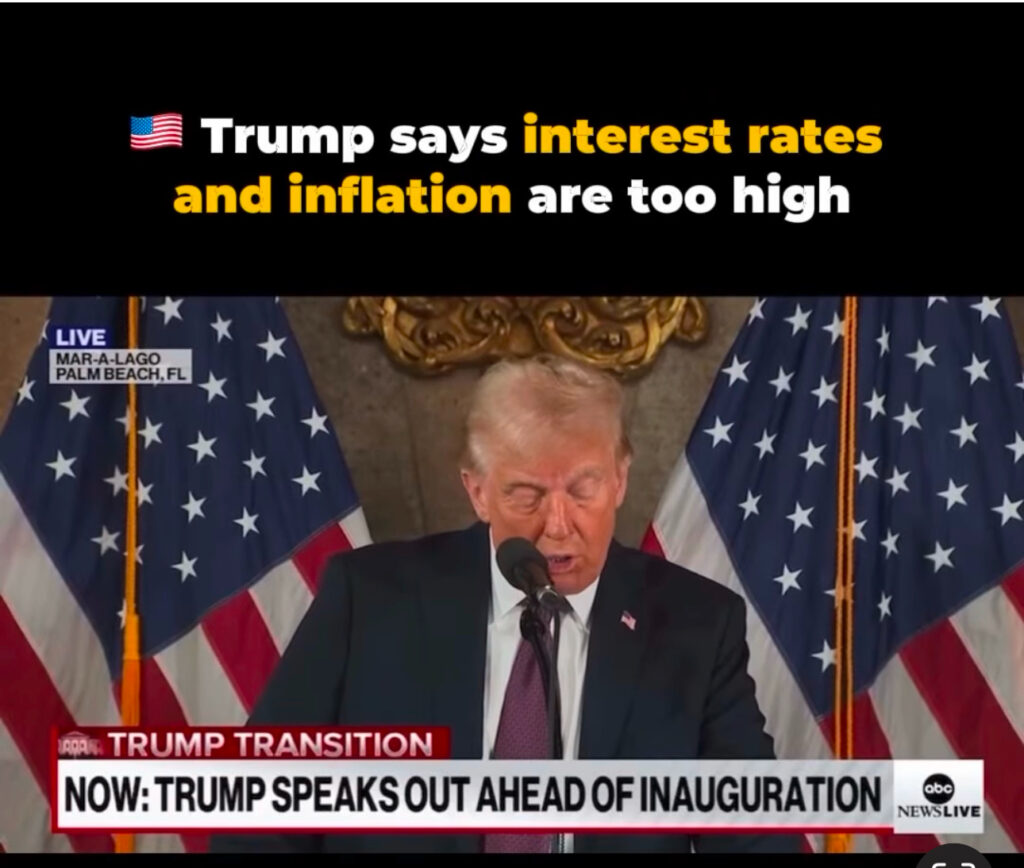
Recent dips in traditional markets and Bitcoin have sparked conversations, with many pointing to Donald Trump’s remarks on high interest rates and persistent inflation. Here’s what’s happening and what could be next.

What’s Behind the Market Dip?

1. High Interest Rates:

• The Federal Reserve’s stance of maintaining higher interest rates has created headwinds for both traditional and crypto markets. High rates make borrowing expensive, reduce liquidity, and pressure riskier assets like Bitcoin.

2. Inflation Concerns:

• Although inflation has cooled from its 2022 peaks, it remains above the Fed’s 2% target. Persistent inflation reduces purchasing power and leaves the Fed little room to lower rates aggressively.

3. Trump’s Comments:

• Former President Donald Trump called attention to high interest rates and inflation as major economic threats, echoing concerns shared by investors. His remarks may have heightened market jitters, fueling sell-offs.

4. Crypto-Specific Weakness:

• Bitcoin and cryptocurrencies are particularly sensitive to macroeconomic conditions. High interest rates reduce demand for speculative assets, and with fewer new buyers entering the market, prices have dipped.

What’s Next for Markets and Bitcoin?

1. Federal Reserve Decisions:

• Markets will closely watch the Fed’s actions in 2025. If inflation moderates, the Fed could cut rates, providing relief to both equities and crypto. However, a stubbornly high inflation rate might keep rates elevated, sustaining pressure on risk assets.

2. Earnings and Economic Data:

• Corporate earnings, unemployment figures, and inflation reports will shape market sentiment. Any signs of economic slowdown could trigger a pivot to more accommodative policies.

3. Bitcoin’s Long-Term Outlook:

• Despite near-term challenges, Bitcoin’s fundamentals remain strong. Adoption continues to grow, and the next halving event in 2024 is likely to tighten supply, which historically has supported price growth in the medium term.

What Can Investors Do?

1. Stay Diversified:

• Don’t put all your eggs in one basket. Spread your investments across traditional assets, crypto, and inflation-resistant sectors like commodities.

2. Monitor Economic Indicators:

• Keep an eye on inflation, GDP growth, and Fed policy announcements. These will set the tone for markets in 2025.

3. Focus on Fundamentals:

• For Bitcoin enthusiasts, price dips can present buying opportunities. If your conviction in crypto’s long-term potential remains strong, this could be a time to accumulate.

4. Be Patient:

• Volatility is normal in uncertain times. Avoid knee-jerk reactions and focus on your long-term investment strategy.

Conclusion

High interest rates and inflation are creating challenging conditions for both traditional and crypto markets. While short-term pain is evident, the long-term outlook for Bitcoin and equities remains cautiously optimistic, especially if inflation moderates and the Fed adjusts its policies. For now, staying informed and diversified is the best way forward.