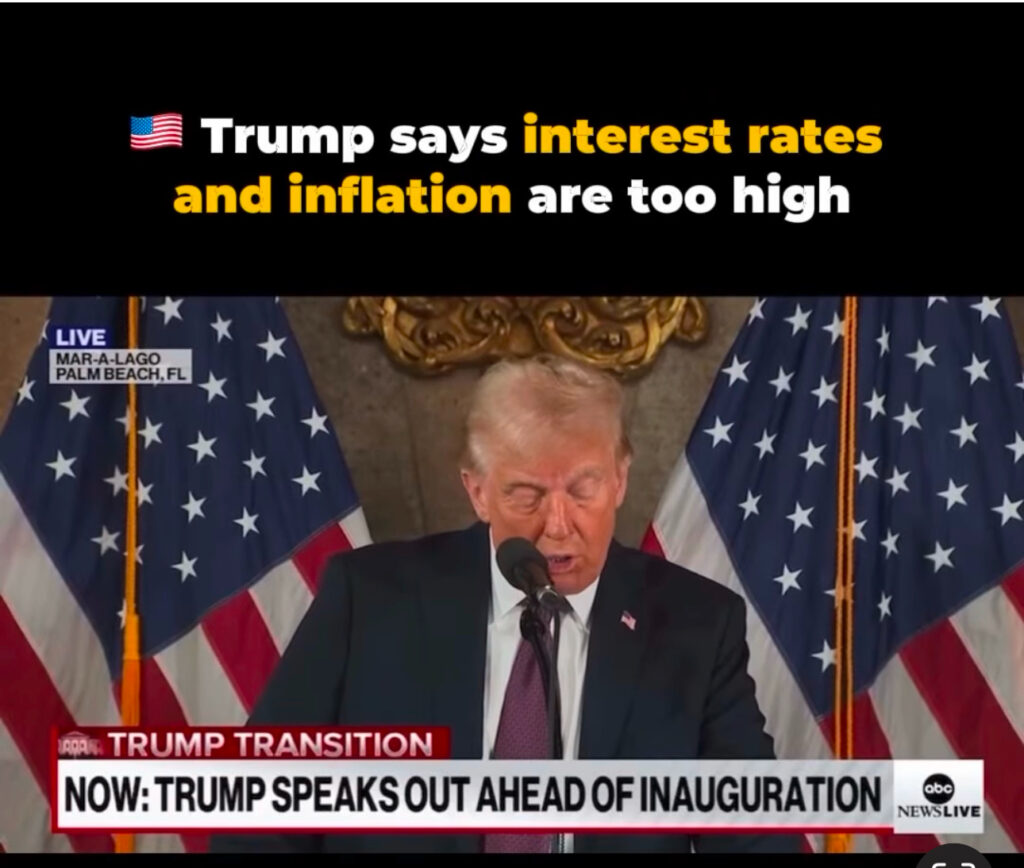
Recent dips in traditional markets and Bitcoin have sparked conversations, with many pointing to Donald Trump’s remarks on high interest rates and persistent inflation. Here’s what’s happening and what could be next.
What’s Behind the Market Dip?
1. High Interest Rates:
• The Federal Reserve’s stance of maintaining higher interest rates has created headwinds for both traditional and crypto markets. High rates make borrowing expensive, reduce liquidity, and pressure riskier assets like Bitcoin.
2. Inflation Concerns:
• Although inflation has cooled from its 2022 peaks, it remains above the Fed’s 2% target. Persistent inflation reduces purchasing power and leaves the Fed little room to lower rates aggressively.
3. Trump’s Comments:
• Former President Donald Trump called attention to high interest rates and inflation as major economic threats, echoing concerns shared by investors. His remarks may have heightened market jitters, fueling sell-offs.
4. Crypto-Specific Weakness:
• Bitcoin and cryptocurrencies are particularly sensitive to macroeconomic conditions. High interest rates reduce demand for speculative assets, and with fewer new buyers entering the market, prices have dipped.
What’s Next for Markets and Bitcoin?
1. Federal Reserve Decisions:
• Markets will closely watch the Fed’s actions in 2025. If inflation moderates, the Fed could cut rates, providing relief to both equities and crypto. However, a stubbornly high inflation rate might keep rates elevated, sustaining pressure on risk assets.
2. Earnings and Economic Data:
• Corporate earnings, unemployment figures, and inflation reports will shape market sentiment. Any signs of economic slowdown could trigger a pivot to more accommodative policies.
3. Bitcoin’s Long-Term Outlook:
• Despite near-term challenges, Bitcoin’s fundamentals remain strong. Adoption continues to grow, and the next halving event in 2024 is likely to tighten supply, which historically has supported price growth in the medium term.
What Can Investors Do?
1. Stay Diversified:
• Don’t put all your eggs in one basket. Spread your investments across traditional assets, crypto, and inflation-resistant sectors like commodities.
2. Monitor Economic Indicators:
• Keep an eye on inflation, GDP growth, and Fed policy announcements. These will set the tone for markets in 2025.
3. Focus on Fundamentals:
• For Bitcoin enthusiasts, price dips can present buying opportunities. If your conviction in crypto’s long-term potential remains strong, this could be a time to accumulate.
4. Be Patient:
• Volatility is normal in uncertain times. Avoid knee-jerk reactions and focus on your long-term investment strategy.
Conclusion
High interest rates and inflation are creating challenging conditions for both traditional and crypto markets. While short-term pain is evident, the long-term outlook for Bitcoin and equities remains cautiously optimistic, especially if inflation moderates and the Fed adjusts its policies. For now, staying informed and diversified is the best way forward.
Investing in cryptocurrencies can be exciting and rewarding, but it’s essential to approach it with caution and strategy. This guide will help you understand the basics and make informed decisions while minimizing risks.
1. Understand the Basics
Before diving in, familiarize yourself with key terms and concepts:
Cryptocurrency: Digital or virtual currencies secured by cryptography (e.g., Bitcoin, Ethereum).
Blockchain: The technology that powers cryptocurrencies by maintaining a decentralized ledger.
Wallet: A digital tool for storing, sending, and receiving cryptocurrencies.
Tip: Start by researching popular cryptocurrencies like Bitcoin (BTC) and Ethereum (ETH) before exploring smaller projects.
2. Assess Your Financial Situation
Only invest money you can afford to lose. Cryptocurrencies are highly volatile, and prices can fluctuate dramatically.
Create an investment budget.
Build an emergency fund before allocating money to crypto.
Diversify your investments to balance risk.
3. Choose a Reliable Exchange
Select a trusted platform to buy and trade cryptocurrencies. Look for:
Security Features: Two-factor authentication (2FA), encryption, and cold storage.
Ease of Use: User-friendly interfaces for beginners.
Reputation: Platforms like Coinbase, Binance, and Crypto.com are widely recognized.
4. Secure Your Investments
Protect your cryptocurrencies by using secure storage solutions:
Hot Wallets: Convenient for frequent trading but vulnerable to online threats.
Cold Wallets: Offline storage, such as hardware wallets, offering maximum security.
Avoid sharing your private keys or passwords.
5. Start Small and Stay Informed
Begin with a small amount to get familiar with the process.
Regularly follow crypto news and trends from reliable sources.
Learn about emerging technologies and updates in the crypto space.
6. Beware of Scams
Avoid “get rich quick” schemes or unsolicited investment offers.
Verify the authenticity of any platform or project before investing.
Use official websites and links to avoid phishing attacks.
7. Long-Term Perspective
Cryptocurrencies can be a long-term investment. Avoid panic selling during market dips and focus on projects with solid fundamentals.
Remember: Patience is key.
8. Learn About Taxes and Regulations
Understand your country’s tax policies on crypto gains and abide by local regulations. Responsible investing includes reporting earnings correctly.
9. Tools and Resources
Portfolio Trackers: Apps like CoinGecko or Blockfolio to monitor your investments.
Investing in cryptocurrencies responsibly requires knowledge, discipline, and a long-term approach. By following these tips, you can confidently take your first steps in the world of digital assets.
Explore More Resources
Check out our latest articles and tools to help you succeed in crypto investing at Future Finance Lab!
The cryptocurrency landscape remains as dynamic as ever, shaped by global economic factors, regulatory shifts, and technological advancements. While major players like Bitcoin continue to hold a significant share of the market’s attention, other assets like HBAR (Hedera), STX (Stacks), and XRP (Ripple) are emerging with unique value propositions that appeal to both retail and institutional investors.
At Future Finance Lab, we’re committed to keeping you informed about the latest in market sentiment and trends across these key assets. Here’s an overview of where each of these cryptocurrencies stands in today’s market and what the sentiment suggests about potential future performance.
Bitcoin (BTC): The Market’s Leading Indicator
Bitcoin has recently surged, reaching around $88,980 according to the latest data. Its resilience at this price level has reinforced confidence among investors, even as global economic conditions remain uncertain. The sharp increase in trading volume suggests a strong influx of new investments, potentially from institutional players and retail traders re-entering the market.
Sentiment Analysis:
Sentiment around Bitcoin remains overwhelmingly positive, with many market participants closely watching the $90,000 threshold as a psychological level. Breaking above this mark could set the stage for further upside, although some investors are cautious about short-term volatility.
Key Takeaway: Bitcoin’s recent surge strengthens its position as the market leader, setting a positive tone across the crypto space. The sentiment is optimistic but tempered by volatility concerns as BTC approaches $90,000.
Ethereum (ETH): Facing Resistance
Ethereum (ETH) is currently priced around $3,271 and has seen some consolidation as it struggles to break through recent resistance levels. While the broader market is bullish, Ethereum has faced minor pullbacks, likely due to profit-taking and a rotation of capital into Bitcoin.
Sentiment Analysis:
Ethereum’s sentiment is mixed, with long-term believers confident in ETH’s role in DeFi and NFTs, while short-term traders are eyeing potential retracements. As ETH remains below $3,300, its near-term price action might be somewhat constrained by market rotation into Bitcoin.
Key Takeaway: While sentiment around Ethereum is still positive, it’s somewhat overshadowed by Bitcoin’s strong performance. ETH may continue to consolidate around its current price levels before a potential upward movement.
HBAR (Hedera): Gaining Traction Through Partnerships
Hedera Hashgraph (HBAR) has climbed to $0.0666, reflecting a strong 24-hour increase of approximately 17.89%. The project’s partnerships, particularly in the finance and supply chain sectors, are boosting HBAR’s market sentiment. Hedera’s unique Hashgraph consensus is drawing attention for its speed and efficiency, especially in enterprise solutions.
Sentiment Analysis:
The market mood around HBAR is increasingly positive, with many investors looking at it as a potential long-term hold given its growing adoption in enterprise applications. The recent spike in price activity suggests rising confidence in Hedera’s roadmap.
Key Takeaway: HBAR is positioned well as a scalable solution for businesses, and its sentiment is largely driven by recent partnerships and enterprise adoption. With strong recent gains, it remains a key asset to watch.
STX (Stacks): Building DeFi on Bitcoin
Stacks (STX) is priced at $2.023, showing resilience in a competitive market. As one of the primary platforms enabling DeFi on Bitcoin, Stacks has gained attention for bringing smart contract functionality to the Bitcoin ecosystem, which could significantly broaden BTC’s use cases.
Sentiment Analysis:
Investor sentiment toward STX is growing, especially as Bitcoin’s recent rally highlights the potential of DeFi solutions that build on BTC’s security and reputation. Stacks is likely to see increased activity as the DeFi sector matures, with more developers exploring its capabilities.
Key Takeaway: STX benefits from the current Bitcoin momentum and offers investors a unique value proposition within Bitcoin-centric DeFi. Market sentiment remains positive, with expectations of further innovation.
XRP (Ripple): Momentum from Legal Wins and Regulatory Clarity
XRP is priced at $0.7125 and has risen by approximately 15.27% over the past 24 hours. Positive sentiment continues to build around Ripple’s XRP, fueled by favorable developments in Ripple’s legal case with the SEC. Investors are optimistic that a regulatory victory could propel XRP to new heights, particularly within the financial services industry.
Sentiment Analysis:
XRP’s sentiment is bullish as legal clarity appears within reach. The positive trend suggests that investors are betting on XRP’s potential to reshape cross-border payments if regulatory barriers are lifted.
Key Takeaway: XRP’s sentiment is strongly tied to its regulatory journey, with rising optimism about its future adoption in financial services. The asset has shown strong recent gains as investors weigh in on possible legal outcomes.
Across the board, the mood within the cryptocurrency market is cautiously optimistic. Bitcoin’s impressive rally is setting a bullish tone, while altcoins like HBAR, STX, and XRP are gaining attention for their unique value propositions. That said, the market remains sensitive to broader economic indicators and regulatory shifts, so investors should proceed with a balanced view of opportunities and risks.
Conclusion: Staying Informed and Strategic
As the market evolves, so does sentiment around key assets like Bitcoin, HBAR, STX, and XRP. Each of these cryptocurrencies is positioned to address different needs within the digital finance landscape, from a store of value and enterprise applications to DeFi and cross-border payments. Understanding the sentiment and trends around these assets can help investors make informed decisions in a rapidly changing environment.
At Future Finance Lab, we’re committed to providing you with timely insights on the market’s biggest players and emerging assets alike. Stay tuned for more updates and analysis to keep a pulse on the market’s ever-shifting mood and sentiment.
Stay Connected with Us
Follow Future Finance Lab for more insights on digital assets, market trends, and crypto sentiment analysis.
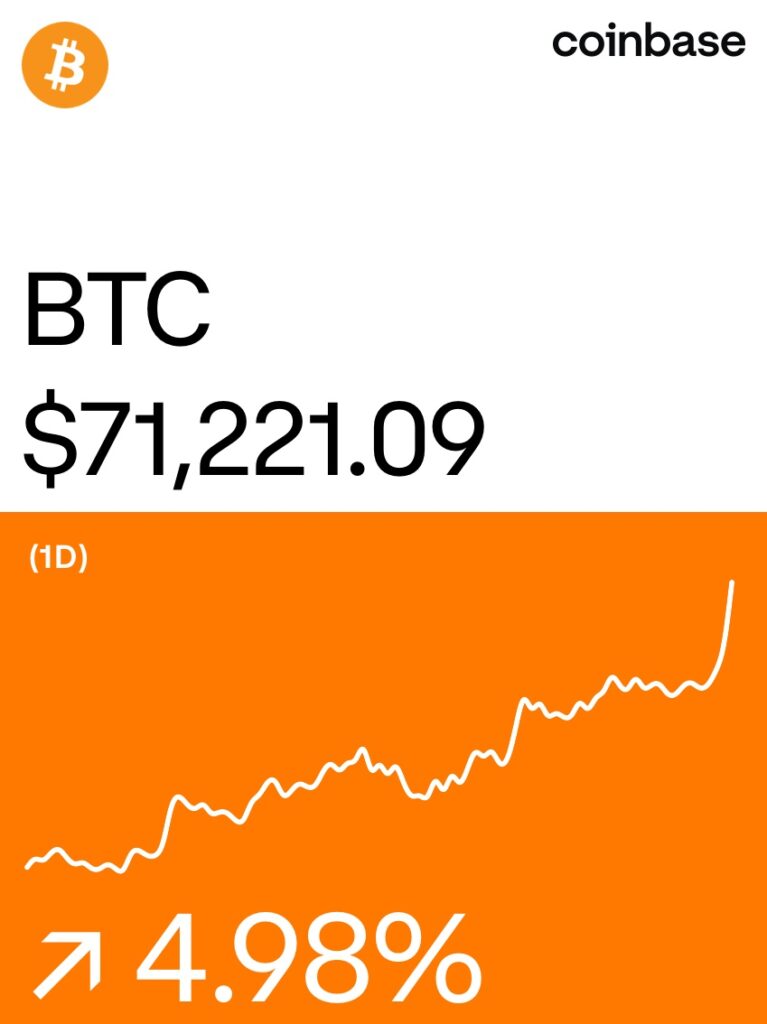
Bitcoin recently soared past $71,000, marking a nearly 5% daily gain and sparking renewed enthusiasm in the market. The rally, occurring just after Bitcoin’s latest halving, reflects a unique combination of reduced supply, institutional interest, and economic conditions pushing investors toward alternative assets. Here’s a look at the key factors driving this surge and what might lie ahead.
Key Drivers Behind Bitcoin’s Rally
1. Institutional Demand and ETF Hopes
The potential approval of a U.S. spot Bitcoin ETF is a significant catalyst. Such an ETF would make Bitcoin accessible to mainstream investors through traditional financial channels. Major institutions like BlackRock and Fidelity are backing ETF applications, fueling optimism that approval could bring billions in new demand, pushing prices higher.
2. Reduced Post-Halving Supply
With the recent halving, the reward for Bitcoin miners has been cut in half, limiting new supply. Historically, these post-halving periods have seen price increases as demand outpaces available Bitcoin, and current price action suggests this dynamic is playing out again.
3. Economic Uncertainty Driving Demand
Global economic instability, inflation, and high-interest rates are leading investors to consider Bitcoin as a hedge. As “digital gold,” Bitcoin’s appeal grows in uncertain times, attracting both retail and institutional investors.
What’s Next for Bitcoin?
Short-Term Outlook
While profit-taking could cause minor pullbacks, if Bitcoin maintains support above $70,000, it may continue its upward momentum. However, the market remains sensitive to regulatory news, especially regarding the ETF approval.
Long-Term Potential
Post-halving, Bitcoin is positioned for sustained growth, driven by reduced supply, institutional accumulation, and wider adoption. If an ETF is approved, it could unlock substantial demand, possibly leading to a sustained bull run.
Final Thoughts
Bitcoin’s rise to $71,000 reflects strong post-halving dynamics, optimism around an ETF, and a global search for inflation-resistant assets. This rally could mark the beginning of a more mature phase for Bitcoin, with growing legitimacy and integration into the broader financial system. For investors, Bitcoin’s journey seems poised to continue upward, backed by both new demand and a shrinking supply.
• Bitcoin’s price surged past $69,000, driven by optimism for potential all-time highs, as it enters a historically bullish period for crypto markets. The U.S. election campaign, with a possible Trump victory, adds to this positive sentiment due to his pro-crypto stance. Additionally, the market cap for USDT hit a record $120 billion, signaling increased confidence in stablecoins and the broader crypto market .
• Retail interest in crypto is rising, with a notable shift toward derivatives trading, which reached $260 billion in volume this month. This trend shows retail investors favoring derivatives over spot trading, adding to overall market activity .
2. Regulatory and Institutional Developments:
• The SEC’s approval of options trading for spot Bitcoin ETFs on major U.S. exchanges signals increased institutional involvement. This development is anticipated to further strengthen the Bitcoin market. Additionally, Pennsylvania’s proposed “Bitcoin Rights Bill” could enhance state-level support for Bitcoin transactions .
3. Layer 2 Growth and Tokenization:
• Ethereum is facing challenges in retaining a deflationary model, as Layer 2 solutions drive down mainnet activity. Meanwhile, tokenization of real-world assets (RWAs) like private credit and U.S. treasuries has grown significantly, exceeding $12 billion and highlighting blockchain’s appeal for tangible asset management .
4. Security and DeFi:
• Security remains a concern, with $1.3 billion lost in hacks in 2024, although security measures are improving. DeFi has seen positive growth, with total value locked (TVL) up 9.6%, led by chains like Sui and Sei that have introduced protocol upgrades, increasing their DeFi activity .
These developments reveal a market driven by institutional confidence and technological progress, even as challenges persist around security and regulatory clarity.