Crypto markets are trending downward. Volatility is high, but downturns often set the stage for future opportunities. Here’s a breakdown of what’s happening ⬇️
2/9
📉 #Bitcoin (BTC): $93,211.67 (-3.13%)
BTC’s pullback reflects broader market caution. With strong support at key levels, this dip may consolidate before the next big move. Eyes on macro trends like liquidity and rate expectations.
3/9
📉 #Ethereum (ETH): $3,314.21 (-4.71%)
ETH’s sharper decline highlights risk aversion in altcoin markets. However, its network upgrades and staking momentum keep the long-term outlook intact. Short-term patience could pay off.
4/9
📉 #XRP: $1.36 (-4.08%)
XRP follows the market downturn but remains resilient given its regulatory clarity in the U.S. Long-term accumulation could be a theme here as adoption grows.
5/9
📉 Mid-Cap Moves:
• $ARB: $0.86 (-7.29%)
• $STX: $2.08 (-5.17%)
Scaling solutions and blockchain-specific projects are taking a hit. These dips often present opportunities for accumulating solid projects with utility and adoption.
6/9
🚨 Alts Leading Declines:
• $SAND: $0.62 (-19.82%)
• $AR: $19.40 (-11.90%)
Speculative tokens like SAND and storage protocols like AR face steep corrections. Risk management is key in sectors reliant on future growth.
7/9
✅ Stablecoins Hold Strong:
• $USDC: $1.0001 (+0.01%)
Capital is flowing into stablecoins amid the sell-off. This signals caution, but it also shows dry powder waiting to re-enter when confidence returns.
8/9
🌊 Macro Takeaway:
Risk-off sentiment is pressuring speculative assets. This is likely tied to global rate hikes and liquidity concerns. Smart money watches these dips for strategic entries.
9/9
📌 What’s Next:
• Bitcoin: Watch for key support at $90,000 to $92,000.
• ETH: $3,000 is a critical level to hold.
• Alts: Focus on utility-driven projects, not hype.
This market phase is challenging, but every cycle rewards the patient. Stay sharp.
Investing in cryptocurrencies can be exciting and rewarding, but it’s essential to approach it with caution and strategy. This guide will help you understand the basics and make informed decisions while minimizing risks.
1. Understand the Basics
Before diving in, familiarize yourself with key terms and concepts:
Cryptocurrency: Digital or virtual currencies secured by cryptography (e.g., Bitcoin, Ethereum).
Blockchain: The technology that powers cryptocurrencies by maintaining a decentralized ledger.
Wallet: A digital tool for storing, sending, and receiving cryptocurrencies.
Tip: Start by researching popular cryptocurrencies like Bitcoin (BTC) and Ethereum (ETH) before exploring smaller projects.
2. Assess Your Financial Situation
Only invest money you can afford to lose. Cryptocurrencies are highly volatile, and prices can fluctuate dramatically.
Create an investment budget.
Build an emergency fund before allocating money to crypto.
Diversify your investments to balance risk.
3. Choose a Reliable Exchange
Select a trusted platform to buy and trade cryptocurrencies. Look for:
Security Features: Two-factor authentication (2FA), encryption, and cold storage.
Ease of Use: User-friendly interfaces for beginners.
Reputation: Platforms like Coinbase, Binance, and Crypto.com are widely recognized.
4. Secure Your Investments
Protect your cryptocurrencies by using secure storage solutions:
Hot Wallets: Convenient for frequent trading but vulnerable to online threats.
Cold Wallets: Offline storage, such as hardware wallets, offering maximum security.
Avoid sharing your private keys or passwords.
5. Start Small and Stay Informed
Begin with a small amount to get familiar with the process.
Regularly follow crypto news and trends from reliable sources.
Learn about emerging technologies and updates in the crypto space.
6. Beware of Scams
Avoid “get rich quick” schemes or unsolicited investment offers.
Verify the authenticity of any platform or project before investing.
Use official websites and links to avoid phishing attacks.
7. Long-Term Perspective
Cryptocurrencies can be a long-term investment. Avoid panic selling during market dips and focus on projects with solid fundamentals.
Remember: Patience is key.
8. Learn About Taxes and Regulations
Understand your country’s tax policies on crypto gains and abide by local regulations. Responsible investing includes reporting earnings correctly.
9. Tools and Resources
Portfolio Trackers: Apps like CoinGecko or Blockfolio to monitor your investments.
Investing in cryptocurrencies responsibly requires knowledge, discipline, and a long-term approach. By following these tips, you can confidently take your first steps in the world of digital assets.
Explore More Resources
Check out our latest articles and tools to help you succeed in crypto investing at Future Finance Lab!
Bitcoin is experiencing a seismic shift. Initially envisioned as a decentralized, peer-to-peer currency free from government control, it’s now being embraced by governments and corporations alike for its stability, scarcity, and potential as a global hedge against economic risks. The U.S. recently introduced the BITCOIN Act of 2024, exploring Bitcoin as a strategic reserve asset, and companies like Thumzup Media are adopting it as part of their treasury strategies. These developments, combined with ETFs like BlackRock’s Bitcoin fund gaining traction, show that Bitcoin is becoming mainstream.
But here’s the big question: Does this compromise Bitcoin’s original vision?
A Shift Away from Decentralization?
Bitcoin was built to separate money from government influence. Its decentralized nature means no single entity can control it, offering financial independence to individuals, especially in countries with economic instability or authoritarian regimes. However, as nations and corporations adopt Bitcoin, it risks becoming entangled with the very institutions it was designed to bypass. Governments holding Bitcoin reserves or regulating its use may dilute its revolutionary ethos.
Why This Shift?
1. Legitimacy and Stability: Governments and institutions see Bitcoin’s fixed supply as a hedge against inflation and currency volatility.
2. Global Competition: Countries may adopt Bitcoin to remain competitive, especially as others—like El Salvador—benefit from its integration.
3. Game Theory in Play: Corporations and nations are joining the Bitcoin bandwagon to avoid being left behind, further reinforcing its adoption.
A Necessary Compromise?
For Bitcoin purists, this shift feels like a betrayal. However, some argue that this “Trojan Horse” moment could bring decentralized ideals into traditional systems. Even with government adoption, Bitcoin remains a powerful tool for individual financial sovereignty, and its growing mainstream role may help educate the world about its potential.
Ultimately, Bitcoin’s evolution is both a triumph and a challenge. Its rise as a reserve asset signals its importance, but it also forces us to ask whether Bitcoin can balance its decentralized roots with its growing acceptance by the establishment. One thing is certain: the world is watching as Bitcoin reshapes the financial landscape.
As crypto markets heat up with Bitcoin nearing all-time highs around $91,000, predictions suggest that major assets like XRP, Hedera (HBAR), and Stacks (STX) could see transformative growth. Here’s a look at what’s next for these key players as they capitalize on institutional interest, regulatory clarity, and market expansion.
1. Bitcoin: $100,000 and Beyond?
Many analysts believe that Bitcoin’s current trajectory could lead it to surpass the $100,000 mark in the near term. With strong institutional backing and the recent success of Bitcoin ETFs, the door is now open for billions in new capital. As Larry Fink of BlackRock describes Bitcoin as “digital gold,” Bitcoin’s role as a store of value could solidify further, making it a key asset in diversified portfolios.
Predictions for 2025 range from $150,000 to $250,000 if institutional demand holds steady and broader adoption continues. Bitcoin’s limited supply and increasing acceptance as a hedge against inflation could further fuel its rise, positioning it as a stable choice in the world of digital finance.
2. XRP: Poised for Global Payment Dominance?
XRP’s role in cross-border payments could see a major boost as Ripple’s legal battles with the SEC come to an end. Some analysts predict that if Ripple fully resolves its regulatory issues, XRP could hit $1 to $2 in the next year, particularly as it gains adoption among banks and payment networks.
Ripple’s partnerships with major exchanges and the development of an XRP-backed stablecoin could position XRP as a critical tool in global finance. If XRP can establish itself as a bridge currency in international payments, it could eventually compete with traditional systems like SWIFT, especially in emerging markets.
3. HBAR: The Future of Enterprise Blockchain?
Hedera’s HBAR, currently around $0.06, is projected to grow as more corporations adopt blockchain for supply chains, data management, and financial services. With its high speed and energy efficiency, HBAR could reach $0.15 to $0.25 by 2025 if adoption by enterprises continues to rise.
HBAR’s partnerships with major firms like IBM and Google hint at its potential as the blockchain of choice for big businesses. Hedera’s governance model, which includes industry leaders, could make it particularly appealing to enterprises looking for a secure and scalable solution that meets regulatory standards.
4. Stacks (STX): Expanding Bitcoin’s Ecosystem
Stacks, which enables smart contracts on Bitcoin, has gained momentum as Bitcoin itself reaches new heights. Predictions for STX range from $3 to $5 by 2025, especially if Bitcoin’s popularity continues to attract developers to Stacks’ ecosystem.
By enabling DeFi and NFTs on Bitcoin’s secure network, Stacks brings new functionality to the original cryptocurrency, which could attract both developers and users interested in decentralized applications. As Bitcoin ETFs increase accessibility, the relevance of Stacks in the Bitcoin ecosystem could grow, making it a promising platform for future development.
Looking Ahead
These assets each bring unique strengths to the crypto market. Bitcoin’s role as “digital gold,” XRP’s potential in global finance, HBAR’s appeal to enterprises, and Stacks’ expansion of Bitcoin’s utility all point to a bright future. As 2024 unfolds, regulatory clarity and institutional interest may continue to drive momentum, potentially setting the stage for transformative growth across these digital assets.
At Future Finance Lab, we’re dedicated to bringing you timely insights on the market’s biggest players and emerging assets alike. Stay tuned for more updates and analysis to keep a pulse on the market’s ever-shifting mood and sentiment.
The cryptocurrency landscape remains as dynamic as ever, shaped by global economic factors, regulatory shifts, and technological advancements. While major players like Bitcoin continue to hold a significant share of the market’s attention, other assets like HBAR (Hedera), STX (Stacks), and XRP (Ripple) are emerging with unique value propositions that appeal to both retail and institutional investors.
At Future Finance Lab, we’re committed to keeping you informed about the latest in market sentiment and trends across these key assets. Here’s an overview of where each of these cryptocurrencies stands in today’s market and what the sentiment suggests about potential future performance.
Bitcoin (BTC): The Market’s Leading Indicator
Bitcoin has recently surged, reaching around $88,980 according to the latest data. Its resilience at this price level has reinforced confidence among investors, even as global economic conditions remain uncertain. The sharp increase in trading volume suggests a strong influx of new investments, potentially from institutional players and retail traders re-entering the market.
Sentiment Analysis:
Sentiment around Bitcoin remains overwhelmingly positive, with many market participants closely watching the $90,000 threshold as a psychological level. Breaking above this mark could set the stage for further upside, although some investors are cautious about short-term volatility.
Key Takeaway: Bitcoin’s recent surge strengthens its position as the market leader, setting a positive tone across the crypto space. The sentiment is optimistic but tempered by volatility concerns as BTC approaches $90,000.
Ethereum (ETH): Facing Resistance
Ethereum (ETH) is currently priced around $3,271 and has seen some consolidation as it struggles to break through recent resistance levels. While the broader market is bullish, Ethereum has faced minor pullbacks, likely due to profit-taking and a rotation of capital into Bitcoin.
Sentiment Analysis:
Ethereum’s sentiment is mixed, with long-term believers confident in ETH’s role in DeFi and NFTs, while short-term traders are eyeing potential retracements. As ETH remains below $3,300, its near-term price action might be somewhat constrained by market rotation into Bitcoin.
Key Takeaway: While sentiment around Ethereum is still positive, it’s somewhat overshadowed by Bitcoin’s strong performance. ETH may continue to consolidate around its current price levels before a potential upward movement.
HBAR (Hedera): Gaining Traction Through Partnerships
Hedera Hashgraph (HBAR) has climbed to $0.0666, reflecting a strong 24-hour increase of approximately 17.89%. The project’s partnerships, particularly in the finance and supply chain sectors, are boosting HBAR’s market sentiment. Hedera’s unique Hashgraph consensus is drawing attention for its speed and efficiency, especially in enterprise solutions.
Sentiment Analysis:
The market mood around HBAR is increasingly positive, with many investors looking at it as a potential long-term hold given its growing adoption in enterprise applications. The recent spike in price activity suggests rising confidence in Hedera’s roadmap.
Key Takeaway: HBAR is positioned well as a scalable solution for businesses, and its sentiment is largely driven by recent partnerships and enterprise adoption. With strong recent gains, it remains a key asset to watch.
STX (Stacks): Building DeFi on Bitcoin
Stacks (STX) is priced at $2.023, showing resilience in a competitive market. As one of the primary platforms enabling DeFi on Bitcoin, Stacks has gained attention for bringing smart contract functionality to the Bitcoin ecosystem, which could significantly broaden BTC’s use cases.
Sentiment Analysis:
Investor sentiment toward STX is growing, especially as Bitcoin’s recent rally highlights the potential of DeFi solutions that build on BTC’s security and reputation. Stacks is likely to see increased activity as the DeFi sector matures, with more developers exploring its capabilities.
Key Takeaway: STX benefits from the current Bitcoin momentum and offers investors a unique value proposition within Bitcoin-centric DeFi. Market sentiment remains positive, with expectations of further innovation.
XRP (Ripple): Momentum from Legal Wins and Regulatory Clarity
XRP is priced at $0.7125 and has risen by approximately 15.27% over the past 24 hours. Positive sentiment continues to build around Ripple’s XRP, fueled by favorable developments in Ripple’s legal case with the SEC. Investors are optimistic that a regulatory victory could propel XRP to new heights, particularly within the financial services industry.
Sentiment Analysis:
XRP’s sentiment is bullish as legal clarity appears within reach. The positive trend suggests that investors are betting on XRP’s potential to reshape cross-border payments if regulatory barriers are lifted.
Key Takeaway: XRP’s sentiment is strongly tied to its regulatory journey, with rising optimism about its future adoption in financial services. The asset has shown strong recent gains as investors weigh in on possible legal outcomes.
Across the board, the mood within the cryptocurrency market is cautiously optimistic. Bitcoin’s impressive rally is setting a bullish tone, while altcoins like HBAR, STX, and XRP are gaining attention for their unique value propositions. That said, the market remains sensitive to broader economic indicators and regulatory shifts, so investors should proceed with a balanced view of opportunities and risks.
Conclusion: Staying Informed and Strategic
As the market evolves, so does sentiment around key assets like Bitcoin, HBAR, STX, and XRP. Each of these cryptocurrencies is positioned to address different needs within the digital finance landscape, from a store of value and enterprise applications to DeFi and cross-border payments. Understanding the sentiment and trends around these assets can help investors make informed decisions in a rapidly changing environment.
At Future Finance Lab, we’re committed to providing you with timely insights on the market’s biggest players and emerging assets alike. Stay tuned for more updates and analysis to keep a pulse on the market’s ever-shifting mood and sentiment.
Stay Connected with Us
Follow Future Finance Lab for more insights on digital assets, market trends, and crypto sentiment analysis.
Bitcoin’s epic surge past $85,000 has everyone talking—and it’s not just about Bitcoin anymore. As the top cryptocurrency reaches new highs, many are asking: Is an “altcoin season” about to kick off?
Altcoin Season Index: Are We Getting Closer?
The Altcoin Season Index is currently at 40/100, meaning we’re still technically in “Bitcoin Season.” But this index has been inching up, signaling rising interest in altcoins. Typically, a score of 75 or more marks a full altcoin season. If Bitcoin’s momentum cools slightly, we might see the index cross into altcoin season territory soon—historically a period of high returns for altcoins.
XRP’s Legal Battle and New SEC Chairman
Amid Bitcoin’s rally, Ripple’s XRP is fighting a critical legal battle with the SEC, which could shape the future of crypto regulation. The recent appointment of a new SEC chairman has sparked hope that the agency may adopt a more balanced approach. A favorable outcome could boost XRP and strengthen the entire altcoin market by providing much-needed regulatory clarity.
Stacks (STX): DeFi Potential on Bitcoin
Another standout altcoin, Stacks (STX), is riding Bitcoin’s wave by bringing smart contracts to the Bitcoin network. STX is positioned as a bridge between Bitcoin and DeFi, appealing to investors seeking innovation on Bitcoin’s robust blockchain. As Bitcoin rises, STX could see a surge in interest as well.
So, Are We on the Verge of Altcoin Season?
All signs point to potential. The Altcoin Season Index is climbing, Bitcoin’s rally is setting the stage, and key altcoins like XRP and STX are positioned for growth. For retail investors, this could mean exciting opportunities are just around the corner. If Bitcoin consolidates, keep an eye on the index and altcoins for what could be the start of a true altcoin season.
Bitcoin has surged to an all-time high of $77,000, fueled by favorable economic conditions, a pro-crypto U.S. administration, and strong institutional interest. With Bitcoin leading the rally, what’s next for the broader crypto market, especially altcoins?
Why Bitcoin is Soaring
1. Lower Interest Rates: With the Federal Reserve moving toward rate cuts, money is flowing into higher-risk assets like crypto. Lower borrowing costs make crypto more attractive, especially as a hedge against inflation.
2. Pro-Crypto Policies: The U.S. has recently elected a pro-crypto president, raising hopes for clearer, friendlier regulations. This could encourage both retail and institutional investors, opening doors for greater crypto adoption.
3. Institutional Investment: Institutional interest has surged with the approval of Bitcoin ETFs, making it easier for big investors to enter the market. While Bitcoin and Ethereum are their primary focus, increased confidence could lead to capital flowing into altcoins over time.
What’s Next for Altcoins?
With Bitcoin grabbing attention, altcoins like XRP, Hedera (HBAR), and Stacks (STX) could be next if the market shifts toward “altcoin season.” Here’s why:
• XRP: If the SEC’s case with Ripple reaches a positive outcome, it could boost XRP’s role in cross-border payments, attracting new investors.
• HBAR: Known for enterprise applications, Hedera’s partnerships in areas like supply chain and healthcare could drive demand if businesses turn to blockchain.
• STX: Stacks enables DeFi and NFTs on Bitcoin, which could gain interest as Bitcoin’s ecosystem expands.
Will Altcoin Season Follow?
Historically, altcoins often rally after Bitcoin stabilizes at high levels. If Bitcoin holds near its peak, investors may look to altcoins for new growth opportunities, especially those with strong use cases. The market’s current structure suggests that a surge in altcoins could follow if Bitcoin consolidates.
The Takeaway
Bitcoin’s new high represents not just a milestone but a sign of mainstream acceptance for crypto. While Bitcoin currently dominates, altcoins like XRP, HBAR, and STX—with their unique roles in payments, enterprise, and DeFi—could benefit from this wave of interest. As crypto gains broader adoption, both Bitcoin and select altcoins may see continued growth in a more favorable regulatory and economic environment.
• Fair value is the estimated true worth of an asset based on an objective assessment of its financial fundamentals, market conditions, and other relevant factors.
• It represents a price at which a willing buyer and seller would agree to exchange the asset, assuming no undue pressure on either side.
Key Factors in Fair Value
Fair value isn’t just about the current market price; it takes into account a broader view:
• Intrinsic Factors: These are factors directly related to the asset, like revenue, profitability, growth potential, and risk.
• External Factors: These include the economic environment, industry trends, competitive landscape, interest rates, and broader market conditions.
Why Fair Value Matters
• Fair value helps investors determine if an asset is undervalued, overvalued, or fairly priced relative to its “true” worth.
• It’s useful for making investment decisions, as buying assets below fair value can potentially provide higher returns if the market price rises to align with fair value.
Fair Value Calculation Methods
There are several methods to determine fair value, each depending on the type of asset (stocks, bonds, real estate, etc.). Here are some common approaches:
• Discounted Cash Flow (DCF) Analysis:
• Often used for stocks, this method calculates the present value of an asset’s future cash flows, discounted by a rate that reflects the risk.
• Example: If a company is expected to generate $1 million in cash each year and you expect a 10% return, the DCF model helps calculate today’s worth of those future cash flows.
• Comparable Company Analysis (CCA):
• Compares an asset to similar assets that are publicly traded to estimate its value.
• For instance, if a similar company has a price-to-earnings (P/E) ratio of 15, you might apply the same multiple to estimate fair value for another company in the same industry.
• Market Sentiment and Demand:
• In cases like real estate or commodities, supply-demand dynamics can play a role in establishing fair value.
• Fair value for an asset like Bitcoin might be influenced by demand factors, network effects, or scarcity, considering its limited supply.
Example: Fair Value of a Stock
• Let’s say you’re evaluating the fair value of a tech stock. You believe it can generate $50 million annually in free cash flow and has a 5% annual growth rate.
• Using DCF, you discount these future cash flows by your required return rate (say 10%). You’d calculate the present value of each year’s cash flow and sum them to arrive at a fair value for the stock.
• If the market price is below this fair value, it might indicate a buying opportunity; if above, it might suggest the stock is overvalued.
Fair Value in Cryptocurrency
• Cryptocurrencies are unique, as they don’t have traditional cash flows or earnings. Here, fair value is more speculative and often based on:
• Network value (how many people use it),
• Utility (use cases, like cross-border payments for XRP),
• Scarcity (like Bitcoin’s fixed supply of 21 million),
• Market adoption and sentiment (demand dynamics).
7. Interpreting Fair Value and Market Price
• Market Price: The price at which an asset is currently trading. This can be above, below, or equal to fair value.
• Fair Value Discrepancy: Often, the market price diverges from fair value due to market sentiment, hype, fear, or temporary events.
• Undervalued: Market price is below fair value—potential buying opportunity.
• Overvalued: Market price is above fair value—possible caution for sellers.
Real-World Application
To apply fair value analysis:
• Research the asset’s fundamentals and calculate fair value using models that suit its characteristics.
• Compare fair value to the current market price.
• Factor in your own risk tolerance, financial goals, and investment timeframe to make informed decisions.
Summary
In essence, fair value represents a rational price based on an asset’s intrinsic and market factors. It’s a powerful concept, helping you look beyond market noise to focus on the underlying worth of an investment.
The financial landscape is shifting rapidly as Donald Trump’s re-election, anticipated Federal Reserve rate cuts, and the introduction of Bitcoin ETFs fuel a wave of optimism across both traditional markets and the cryptocurrency space. Unlike the last time Bitcoin hit an all-time high, the environment today is uniquely favorable: a pro-Bitcoin president, potential regulatory easing, and the first Bitcoin ETFs are creating conditions for what many see as the next crypto bull run.
Trump’s Return and a Pro-Crypto Stance
Trump’s presidency marks a significant shift for digital assets. The last time Bitcoin reached its all-time high in late 2021, it did so without institutional support through ETFs and without a president publicly favorable toward Bitcoin. Today, Trump’s administration is expected to take a more open approach to cryptocurrency, positioning digital assets as an innovation-friendly sector rather than a regulatory target. This pro-Bitcoin stance, coupled with expectations of eased regulations from a potentially revamped SEC, has invigorated the crypto community, which sees this as a foundation for sustained growth and mainstream adoption.
Bitcoin ETFs and Institutional Access
Another key difference is the availability of Bitcoin ETFs, which could bring a flood of institutional capital to the market. With products that provide easy access to Bitcoin, institutional investors who previously faced regulatory or logistical hurdles are now able to participate in the market. This structural change in access to Bitcoin is expected to be a game-changer, allowing a broad spectrum of investors to enter the market in ways they couldn’t before. The potential of a pro-crypto administration to fast-track ETF approvals further adds to the momentum, and with Trump’s pro-business stance, the path to full regulatory acceptance for crypto looks more promising than ever.
Federal Reserve’s Rate Cuts: Fueling Risk Assets and Crypto
The Fed’s anticipated rate cuts are another powerful catalyst for both the stock and crypto markets. Rate cuts lower the cost of capital, encouraging investment in higher-risk, high-growth assets like tech stocks and cryptocurrencies. This accommodative monetary stance aligns well with Trump’s economic goals, as a lower interest rate environment can stimulate spending, lending, and market optimism. For crypto markets, this could translate to increased demand as investors seek higher returns in a favorable borrowing environment. Additionally, lower rates make Bitcoin’s appeal as a hedge against traditional monetary policies even more compelling.
XRP and Coinbase Rally on Regulatory Hopes
XRP and Coinbase are two standout beneficiaries of the potential regulatory shift. Under the previous administration, the SEC, led by Gary Gensler, aggressively pursued legal action against Ripple (XRP), casting uncertainty over the crypto’s status. With Gensler likely to be replaced, there’s hope that XRP’s prolonged regulatory woes could be alleviated, potentially clearing its path to widespread adoption.
Coinbase, the only major U.S.-listed crypto exchange, has surged more than 20% on the belief that Trump’s pro-business stance will bring a friendlier regulatory environment. As both XRP and Coinbase react to the shifting regulatory landscape, the broader market is seeing this as a strong signal that crypto companies may face fewer hurdles and more regulatory clarity going forward.
A New Geopolitical Climate: War De-escalation and Trade Risks
The geopolitical landscape is also factoring into market sentiment. Hints at de-escalation in global conflicts could lead to easing supply chain disruptions, while successful negotiations could open up more global market opportunities. Although tariffs remain a possible risk, a more stable global economy with less wartime tension could foster stronger global trade relationships, which would likely boost market confidence. Trump’s past stance on tariffs raises concerns, but a shift toward negotiated outcomes rather than trade wars could reduce these risks.
Risks and Rewards: Inflation, Tariffs, and Optimism
Though market sentiment is overwhelmingly optimistic, there are risks. Trump’s focus on economic growth and potential tax reforms could reignite inflation concerns, forcing the Fed to reverse its accommodative stance, potentially destabilizing markets. Tariffs, particularly if re-imposed or escalated, could impact trade costs and consumer prices, affecting companies with international supply chains. However, most investors see these as manageable risks against a backdrop of pro-growth, pro-crypto policies, Fed rate cuts, and a regulatory shift toward clarity rather than confrontation.
Conclusion: The Dawn of a New Market Era?
With Trump’s pro-Bitcoin stance, the Fed’s rate cuts, and the arrival of Bitcoin ETFs, we’re witnessing a convergence of favorable conditions that could propel crypto markets into a new era of growth. Investors are watching closely to see if this alignment of factors will lead to sustained bull markets across both traditional and digital assets, marking a sharp contrast to previous cycles.
While risks such as inflation and tariffs remain, the broader outlook is one of optimism. With a supportive regulatory environment, lower borrowing costs, and mainstream access through ETFs, the stage may be set for Bitcoin and the broader crypto market to reach unprecedented heights. For investors, this could be the beginning of a long-awaited crypto renaissance, underpinned by a unique set of market, regulatory, and geopolitical dynamics not seen in previous cycles.
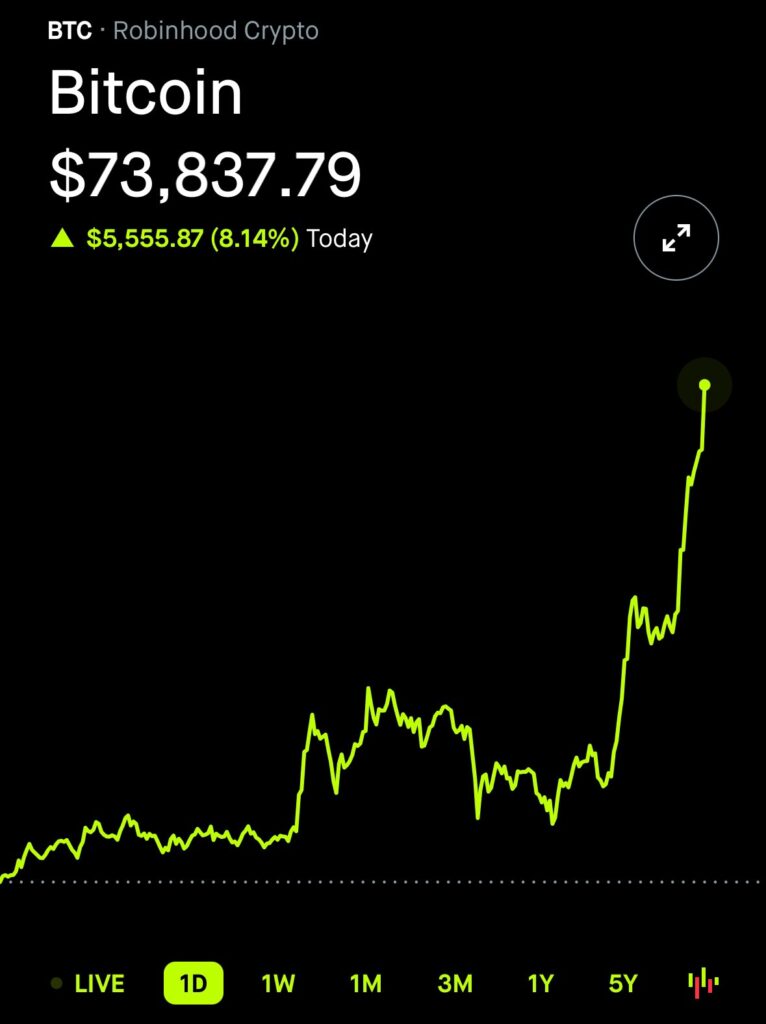
Bitcoin’s recent surge to an all-time high of $74.9K has electrified the financial world. While price rallies are nothing new in the volatile crypto market, this particular movement carries a unique twist—the anticipation of political change in the U.S. With the presidential election on the horizon, a Trump victory could dramatically reshape the landscape for Bitcoin and the broader crypto industry.
Why the Trump Factor?
Donald Trump’s previous administration was marked by deregulation and a willingness to embrace innovation, including aspects of fintech and emerging technologies. While his stance on cryptocurrencies has had mixed interpretations, a return to the White House could signal more lenient regulatory policies, potentially creating a more favorable environment for digital assets.
What This Could Mean for Bitcoin:
1. Pro-Crypto Regulatory Stance: If Trump were to return to office, many analysts believe that we could see a continuation of his deregulatory approach, creating opportunities for Bitcoin and other cryptocurrencies to thrive. A political shift like this could make the U.S. a more attractive hub for crypto firms and investors, pushing Bitcoin prices even higher.
2. Increased Institutional Confidence: Political stability and clear regulatory frameworks are key for large-scale investments. The prospect of policies that favor financial innovation might embolden institutions to deepen their positions in Bitcoin and blockchain technology. A Trump-led administration could remove some of the uncertainty that has kept cautious investors on the sidelines.
3. Global Ripple Effects: A U.S. president supportive of deregulated financial practices could have international implications. Global markets often follow the U.S.’s lead, and a pro-crypto administration could influence other nations to adopt similar stances, accelerating the global acceptance of Bitcoin.
Market Sentiment Speaks Volumes:
The current price surge shows that the market is already factoring in this potential political outcome. Traders are positioning themselves early, betting that the regulatory tide could shift to their favor. Bitcoin’s performance reflects not just a response to domestic politics but an anticipation of how global financial policies might pivot if the U.S. signals a new chapter for cryptocurrency.
Risks and Realities:
However, a Trump victory isn’t a guaranteed win for Bitcoin. While some predict a favorable regulatory shift, others warn that political unpredictability could still pose challenges. Past remarks from Trump himself have been contradictory—once calling Bitcoin a “scam,” but also recognizing the potential of blockchain and fintech.
Looking Forward:
Bitcoin’s climb to $74.9K may just be the beginning of a broader movement influenced by political and financial currents. As the 2024 U.S. presidential election approaches, the crypto world will be watching closely. A Trump victory could pave the way for a new era of digital finance—potentially fast-tracking Bitcoin’s journey toward further institutionalization and adoption.
Conclusion: Embracing a New Financial Era
Whether you’re a seasoned investor or new to the crypto scene, understanding the influence of global politics on the market is essential. A potential Trump win may herald changes that extend far beyond national policies, impacting the global stance on digital assets. Bitcoin’s recent all-time high isn’t just a spike—it could be the start of a transformative period in the financial world.
Stay connected with FutureFinanceLab.com for more insights, analysis, and updates as we navigate this thrilling chapter in crypto and finance.